Key takeaways
- Boca Raton recertification delays are often caused by incomplete or inconsistent reports.
- Missing thermal imaging can lead to additional inspections and resubmissions.
- Incorrect submission procedures through the eHub portal may delay review timelines.
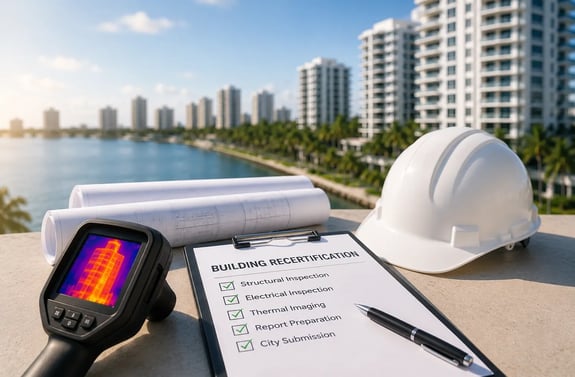
- Coordinating structural, electrical, and thermal inspections early helps avoid back-and-forth.
- Understanding how Boca Raton’s multi-stage review process works can help associations avoid unnecessary costs and delays.
Building recertification in Boca Raton is, in theory, straightforward: Follow the guidelines, submit the required reports, and receive approval.
In practice, however, the process is rarely that simple.
Although the ordinance clearly outlines the requirements, it doesn’t fully reflect how the process often plays out. Through hands-on experience performing recertification inspections in Boca Raton, and by coordinating closely with the city throughout the process, we’ve seen where projects tend to slow down and how small oversights can lead to unnecessary delays.
Over time, clear patterns have emerged.
The good news is that most delays come down to a few common issues. With the right preparation, they can be avoided entirely.
In this article, we’ll walk you through how the Boca Raton recertification process really works, where projects most commonly get held up, and what you can do to keep the process moving as smoothly as possible.
How Does the Boca Raton Building Recertification Process Work?
Boca Raton’s Building Recertification Inspection Program is governed by Ordinance No. 5589, which outlines the structural and electrical inspection requirements. Here is an overview of the Ordinance.
But in practice, the process involves more than what’s written in the Ordinance.
It starts with the inspection. A licensed structural and electrical engineer evaluates the building and prepares the required reports.
Once submitted through the city’s eHub portal the review process begins, but the reports do not go straight to the building official. They are first reviewed by a third-party engineer on behalf of the city. This step is easy to overlook, but it plays an important role in how the process unfolds.
After that review, the reports move on to the building official for final approval.
Because of these steps, Boca Raton recertification is not a one-step submission. It is a multi-stage review process, and each stage needs to be cleared before moving forward.
Even when everything is in order, the review process can take several weeks. If anything is unclear or incomplete, comments are issued and the timeline extends.
Understanding this structure makes a difference. What seems like a simple report submission is, in reality, a coordinated process with multiple checkpoints.
What Causes Delays in Boca Raton Building Recertification?
In practice, delays usually don’t come from the process itself, but from a few recurring issues that show up during review. They are not always obvious, but if you know what to look for, you can prevent them and avoid unnecessary delays in your recertification.
-
Inconsistencies between inspection findings and the report
One common issue is inconsistent reporting. It happens more often than you might expect.
For example, during the review of an electrical inspection report, issues in electrical rooms are sometimes clearly visible in the inspection photos but are not fully described in the report itself. That creates a mismatch between what the reviewer sees and what is documented.
When that happens, the reviewer will ask for clarification. Instead of moving forward with approval, the report needs to be revised and resubmitted. That can slow the process down significantly.
-
Incomplete or unclear reports
Not all delays come from one specific issue. Sometimes the report as a whole leaves too much open to interpretation.
For example, descriptions may be too brief, certain observations are not fully explained, or the connection between findings and conclusions is not entirely clear. From the reviewer’s perspective, that raises questions.
When that happens, they will ask for clarification. That back-and-forth is what adds time and can delay approval, even when the underlying issue is minor.
-
Using the wrong report templates
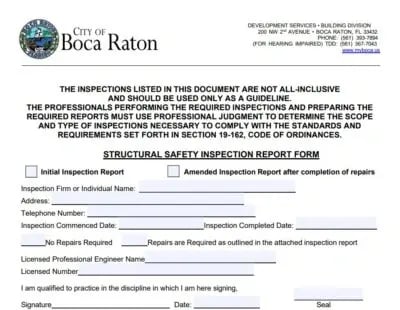 Sometimes, reports are submitted using a format other than the official templates required by the City of Boca Raton. Since the city requires these templates for processing, reports submitted in a different format are typically rejected.
When that happens, the reports need to be redone using the correct templates and resubmitted before the review process can begin. This can delay the timeline significantly before the report even reaches the reviewer or building official.
-
Missing thermal imaging
Another issue that comes up regularly in recertification reports is missing thermal imaging, or infrared thermography, in the electrical inspection report.
While it’s not explicitly listed as a requirement in the ordinance, in practice it is often expected as part of a complete electrical evaluation. This is especially true for buildings with larger or more complex electrical systems.
If thermal imaging is not included where it is expected, the building owner or association will need to arrange for an additional site visit to perform the thermal imaging and update the report before the review can continue.
It not only costs more time but also requires additional coordination and can increase overall costs.
This is one of those areas where the difference between what is written and what is expected becomes clear. When it is missed, it almost always pushes the recertification timeline further out.
-
Submission and portal Issues
Not all delays are related to the inspection itself. In practice, issues can arise during the submission process. Reports may be submitted under the wrong application type, or the required documents are not uploaded in the expected way.
When that happens, the application may not move forward into review right away.
The right steps are easy to overlook, especially when working with the Boca Raton’s eHub portal for the first time, but it can delay the start of the review without it being immediately obvious.
Each of the mentioned issues may seem minor on its own, but they often lead to additional review cycles. That is where time is lost. But with the right preparation and attention to detail, you will help your building move through the recertification process with fewer revisions, less back-and-forth, and a more predictable timeline.
At a glance: When structural inspections, electrical evaluations, and thermal imaging are handled together, it is much easier to deliver a complete report from the start and avoid unnecessary back-and-forth.
Practical tips to keep the process moving
Now that you understand where delays typically come from, the next step is knowing how to avoid them. In practice, a few small decisions early on can make a significant difference in how smoothly the process goes.
-
Work with a team that understands the local process
Recertification is not just about performing an inspection. It’s about understanding how the city reviews reports and what is expected in practice.
Working with engineers who are familiar with Boca Raton’s process helps avoid common issues before the report is even submitted.
-
Start the submission the right way
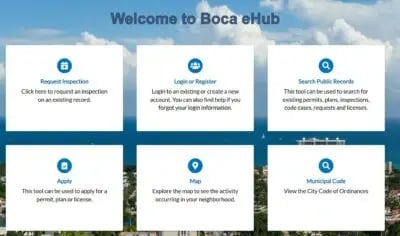 Source: City of Boca Raton eHub portal
The submission process in Boca Raton runs through the city’s eHub portal.
For building recertification, inspection reports should be submitted through the Application process (the button labeled ‘Apply’), not through the Request Inspection function.
Then, search for Building Recertification and move forward from there.
If something is unclear during submission, it is worth confirming the correct approach before proceeding by reaching out to the city’s Recertification Coordinator (find more details here). That alone can save time later.
-
Make sure the report tells the full story
Reviewers don’t just look at the report, they compare it to the supporting documentation.
Before submitting, take a moment to confirm:
• What is shown in the photos is clearly described.
• Observations and conclusions are aligned.
• Nothing is left open to interpretation.
Catching small inconsistencies early can prevent an extra review cycle later.
-
Don’t treat thermal imaging as an afterthought
Even though thermal imaging is not explicitly listed in the requirements, in practice it is often expected as part of a complete electrical evaluation.
If there is any doubt about whether it should be included, it is worth confirming this with an engineer who is familiar with Boca Raton’s recertification process and experienced in both electrical inspections and thermal imaging before submitting the report.
Handling it early avoids the need for revisions and resubmission.
-
Coordinate all inspection scopes from the start
Recertification often involves multiple disciplines: structural, electrical, and in many cases thermal imaging.
When these are handled separately, gaps or inconsistencies are more likely to occur.
When they are coordinated from the start, it becomes much easier to submit a complete and consistent report. This reduces the risk of back-and-forth and helps your building move through the approval process without unnecessary delays.
-
Allow time for review, but avoid unnecessary cycles
Even when everything is done correctly, the review process takes time.
What makes the biggest difference is avoiding additional review cycles. Each request for clarification or revision adds time.
Submitting a complete report from the start is the most effective way to keep the process moving.
A predictable path to approval
Delays in Boca Raton building recertification are rarely caused by the process itself. They usually come down to a few recurring issues: small gaps or misalignment between what is expected and what is submitted.
Once you understand that, the process becomes much easier to navigate.
When the process is understood and handled correctly, recertification becomes far more predictable, and approval can be achieved without unnecessary delays or surprises.
Learn About Building Recertification and more
Campbell Property Management regularly hosts educational webinars focused on milestone inspections, local recertification process, and Florida condominium legislation. Visit CampbellEvents.org for upcoming educational opportunities and events.
Scott Harvey-Lewis is the visionary President and owner of Building Mavens, a preeminent Milestone Inspections and Engineering Consulting Firm based in the heart of Palm Beach Gardens, Florida. As a licensed professional engineer with over a decade of experience and nearly two decades of dedicated engineering expertise, he is exceptionally qualified in delivering a comprehensive suite of services in structural engineering, including design, construction, administration, and forensic analysis, catering to clients and projects across the public and private sectors.