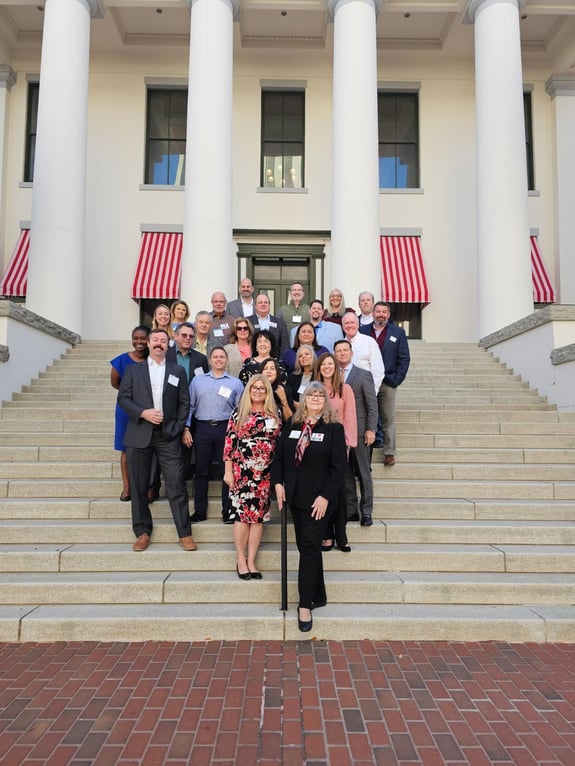
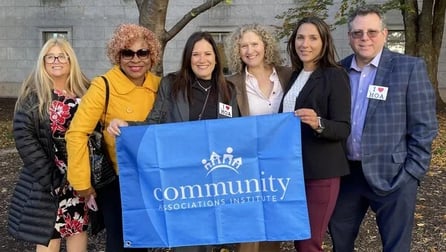
 Campbell Property Management’s Beth Rappaport, VP of Business Development travelled to Washington DC in early November with Community Associations Institute (CAI) to meet with federal legislators and was in Tallahassee mid-month with the CAI Florida Legislative Alliance, meeting with legislators and advocating on behalf of community associations in advance of the 2026 legislative session.
Since its founding in 1987, CAI Florida Legislative Alliance is a diverse group of homeowner leaders, community managers, and business partners serving as a trusted resource for understanding the real-world impact of proposed legislation on community associations. Together, they offer valuable perspectives on how laws affect those who live and work in these unique communities.
The talking points of this session are:
Why Community Associations Matter
- 50,100 community associations in Florida; 369,000 nationwide
- 9.5 million Florida residents and 77.1 million Americans live in these communities
- Associations maintain infrastructure and amenities without relying on taxpayer funding
- CAI’s 2024 National Homeowner Satisfaction Survey:
- 86% rate their experience as good, very good, or neutral
- 82% say their board acts in the community’s best interest
- 72% say their community manager adds value
Condominiums – Smart Implementation Before New Legislation
Florida’s legislature has adopted major reforms to improve condominium safety, structural integrity, and financial preparedness. What these communities, and the marketplace that serves them, needs now, most of all, is consistency, clarity, and time—not new mandates.
CAI requests legislators pursue the following objectives to help the above reforms work:
- Empower the Department of Business & Professional Regulation (DBPR) to adopt rules, definitions, and guidance to help communities comply with current laws.
- Focus on implementation rather than continuous statutory changes.
- Involve CAI-FLA early in discussions on condominium termination, hotel-condo arrangements, reserve structures and similar proposals.
House Bill 255 – CAI Strongly Opposes
- HB 255 repeals tolling of the statute of limitations and repose for construction defect claims.
- Developers can control a condominium association for up to 7 years; the statute of repose is also 7 years. Without tolling, owners lose the ability to pursue defect claims before gaining control of the association.
- The bill also publishes names and home addresses of new volunteer board members online, creating privacy and safety concerns.
CAI supports extending current construction defect protections to homeowners associations (ch. 720).
Homeowners Associations – Strengthen, Don’t Eliminate
Calls to abolish HOAs ignore how they function and the vital role they play in Florida’s housing market. HOAs are contractual communities—homebuyers voluntarily agree to shared responsibilities and governance.
Why banning HOAs is not a practical or responsible solution:
- Eliminating HOAs would shift billions in private obligations—roads, stormwater systems, utilities, amenities—onto local governments and taxpayers.
- Florida law already allows communities to amend or dissolve an HOA through a supermajority vote and legal process.
Areas where clarity can be achieved:
- Parking enforcement and authority
- Election procedures and consistency
- Construction defect timelines and turnover for common areas
- Records requests and retention
Amenity/Club Fees:
- CAI urges caution before making any changes to the way these fees are currently administered by developers.
- Homeowners subjected to these mandatory arrangements should not be harmed in order to further benefit developers.
- Please include CAI’s homeowner perspective if and when this issue is revisited.
Support Professional Management & Education
Community association managers help boards navigate budgets, insurance, reserves, safety compliance, and legal obligations.
CAI supports:
- Reinstating continuing education for licensed managers after 10 years.
- Encouraging or requiring professional designations for managers of large communities, based on budget or number of units.
For more information and resources, click here.