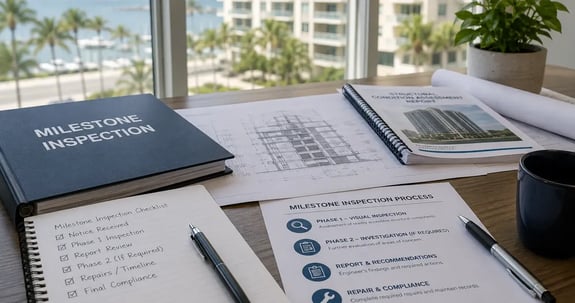
Florida milestone inspections are legally required structural inspections for condominium and cooperative buildings that are three stories or higher once they reach a certain age. The process involves strict deadlines, engineer evaluations, reporting requirements, and, when necessary, structural repairs to help ensure long-term building safety.
Key Takeaways
- Most buildings must begin inspections at 30 years old, or 25 years near the coast.
- Phase 1 inspections must be completed within 180 days after official notice.
- If structural concerns are identified, a Phase 2 inspection may be required.
- Associations may need to begin repairs within 365 days after receiving the report.
If you’ve recently received a notice about a milestone inspection, or you know your building is approaching that age, you’re probably trying to piece together what this actually means for your association.
If it feels a bit unclear, that’s normal.
Most boards are going through this process for the first time. The requirements are specific, the timelines matter, and the terminology isn’t always intuitive. So instead of approaching this as a checklist, it helps to walk through the process the same way you’re likely experiencing it: one question at a time.
What exactly is a milestone inspection in Florida?
At its core, a milestone inspection is a structural inspection of an aging building.
The purpose isn’t to evaluate finishes, maintenance, or appearance. It’s to determine whether there is substantial structural deterioration. In other words, are the building’s structural systems still performing the way they’re supposed to?
This requirement comes from Florida’s building safety legislation, specifically Section 553.899 of the Florida Statutes, which establishes a consistent, statewide approach to structural inspections of aging condominium buildings can be achieved without unnecessary delays or surprises.
Milestone inspection at a glance
-
Required for condos ≥3 stories
-
Starts at 30 years (or 25 near coast)
-
Phase 1 within 180 days after notice
-
Repairs within 365 days if needed
Does our building actually need a milestone inspection?
This is usually the first question boards ask, and the answer depends on two things: height and age.
If your building is a condominium or cooperative that is three stories or higher, it falls under the requirement once it reaches a certain age. That threshold is typically 30 years, or 25 years in coastal areas where local authorities require earlier inspections. From that point forward, the inspection must be repeated every 10 years.
One detail that often gets overlooked is how the building’s age is determined. It’s based on the certificate of occupancy, not when the association was formed.
Note: Some cities and counties have stricter local requirements than the statewide milestone law. In certain cases, factors like building height can affect inspection rules — learn more in our article on how building height can affect safety inspection rules.
When do milestone inspections need to be completed in Florida?
The law introduced specific deadlines depending on when a building reached 30 years of age. Some buildings were required to complete their inspections by the end of 2024, while others fall into the next deadline at the end of 2025. After that initial milestone, inspections continue every 10 years.
In practice, what matters more than the statutory deadline is what happens once your building is officially notified.
How will we know when our building needs a milestone inspection? (And how much time do we really have?)
 For most associations, the process officially begins when they receive a formal notice from the local enforcement agency, typically your city or county building department.
That notice is not informal. It is sent by certified mail to the association (and any other relevant building owners). Once it’s received, the association is required to notify all unit owners within 14 days.
This is when milestone inspections shift from something you’ve heard about to something you’re officially responsible for completing.
At the same time, another clock starts: Phase 1 of the inspection must be completed within 180 days of the enforcement agency’s notice.
Should we start before we receive a notice?
One of the most common questions we hear is whether it makes sense to wait for the official notice or to start earlier.
In practice, starting early makes a significant difference.
If your building is approaching the required age, you don’t have to wait until the notice arrives to begin planning. Once that notice is received, the timeline becomes fixed, and the 180-day window for completing Phase 1 can close faster than expected.
What many boards don’t expect is how much time can be taken up before the inspection even begins. Getting proposals, selecting an engineer, and coordinating access all take time. In busy periods, engineer availability can become limited.
Starting the conversation early gives you more flexibility. It allows you to:
-
evaluate proposals more carefully,
-
avoid scheduling bottlenecks, and
-
approach the process with less pressure.
For boards that already know their building is due, taking that first step early is often the difference between a controlled process and a rushed one.
Who is responsible for a milestone inspection in a condo association?
Even though individual unit owners are part of the ownership structure, the responsibility for arranging the milestone inspection sits with the association.
That means the board is responsible for hiring the professional, coordinating the process, and ensuring everything is completed on time.
The cost is also handled at the association level. It’s a shared responsibility, not something individual owners manage on their own.
Who is qualified to perform a milestone inspection?
(And how do you choose the right engineer?)
A milestone inspection must be performed by a licensed professional engineer or architect, or a team working under one who takes responsibility for the inspection.
But boards quickly realize that licensing alone isn’t the full picture.
Experience matters, especially when it comes to South Florida buildings. The local environment plays a significant role in how structures age. Salt air, humidity, and coastal exposure can accelerate corrosion and concrete deterioration in ways that aren’t as common in other regions.
An engineer who regularly works in this environment understands where problems tend to develop and how to interpret early signs of deterioration in this specific climate.
Just as importantly, familiarity with local jurisdictions and inspection requirements can make the process more efficient, particularly if a Phase 2 investigation becomes necessary.
What parts of the building are actually inspected?
One of the most common questions is how extensive the inspection really is.
The focus is on the structural systems of the building: the elements that carry load and ensure stability. That includes components like slabs, columns, load-bearing walls, balconies, and foundations.
It’s not a cosmetic review. Surface-level issues like cracked paint or finishes are not the focus unless they indicate something structural beneath. And while common areas are the primary focus, access to certain units, especially where structural elements like balconies are involved, may be necessary.
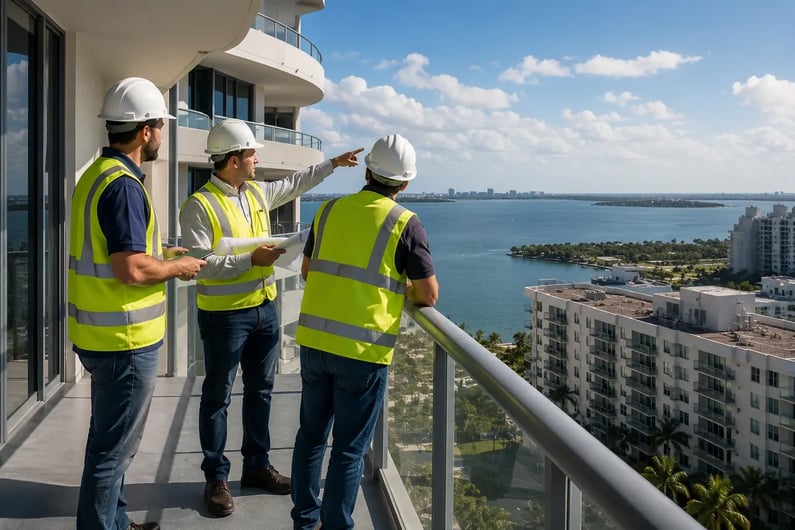
What does the milestone inspection process look like (Phase 1 and Phase 2)?
The process is divided into two phases, though not every building will go through both.
It starts with Phase 1, a visual assessment of the building’s structural components. The goal is to determine whether there are signs of substantial structural deterioration.
Once Phase 1 is complete, a report is submitted to the local enforcement agency.
If no concerns are identified, the process ends there.
If concerns are identified, the inspection moves into Phase 2. This second phase is more detailed. It may involve testing materials, exposing structural elements, or performing analysis to confirm whether the building is structurally sound. It also results in recommendations for repair or further evaluation.
What does a milestone inspection cost, and why does it vary?
This is one of the most common questions boards ask.
The reality is that milestone inspection costs can vary significantly depending on the building. Factors like size, number of stories, accessibility, and whether a Phase 2 inspection is required all play a role.
Because of this, inspections are typically scoped on a case-by-case basis, rather than priced as a fixed service.
For boards, the most useful first step is understanding the scope, because that’s what ultimately determines cost.
Will a milestone inspection find everything wrong with the building?
This is an important expectation to set early. A milestone inspection is designed to evaluate structural integrity. It is not intended to identify every issue in the building.
That means items like finishes, waterproofing details, mechanical systems, or smaller maintenance concerns are generally outside the scope, unless they directly relate to structural performance.
It also means that hidden conditions (issues that don’t present visible indicators) may not be identified during a visual inspection.
Understanding this helps avoid a common misconception: This is not a full building audit. It’s a targeted assessment focused on structural safety—a snapshot of the building at a specific moment in time.
A milestone inspection is not a full building audit. It’s a targeted, visual assessment of structural safety. A snapshot of the building at a specific moment in time.
What is included in a milestone inspection report?
The milestone inspection report is a structured document defined by law.
It outlines what was observed, how the inspection was performed, and whether substantial structural deterioration was identified. It also addresses whether any unsafe conditions exist and what actions are recommended.
A separate summary of findings is prepared specifically for unit owners, and the report must be signed and sealed by the licensed professional responsible for the inspection.
What happens after the milestone inspection is completed?
Once the association receives the report, there are immediate next steps.
The law requires that the summary report be distributed to all unit owners within 45 days. It must also be posted in a visible location, and if the association maintains a website, both the summary and full report must be published there.
This ensures that all owners (not just the board) have access to the results.
What if repairs are required after a milestone inspection?
If the inspection, particularly Phase 2, identifies structural deficiencies, the association must act. Under Florida law, repairs must be commenced within 365 days of receiving the report, unless the local jurisdiction requires action sooner.
Once those repairs are completed, the building must be reinspected, and an updated report must confirm that it is safe for continued occupancy.
Can we get more time to complete a milestone inspection?
In some cases, yes. An extension may be granted if the association can demonstrate that it has already engaged an engineer or architect but cannot reasonably complete the inspection before the deadline.
These extensions must be requested and justified; they are not automatic.
Why do milestone inspections feel more complicated than they are?
For many boards, milestone inspections feel complex not because the process itself is unclear, but because it introduces firm timelines into something that was previously more flexible.
There are deadlines. Reporting obligations. Legal responsibilities.
But when you step back, the process follows a logical path: Receive notice, complete the inspection, understand the findings, and act if needed.
What are the next steps for condo boards?
If you’re at the beginning of this process, the most important step is understanding where your building stands in terms of age and deadlines. From there, everything else becomes easier to plan.
If you’ve already received notice, starting early gives you more control, not just over scheduling but over the decisions that follow.
Learn More About Florida Milestone Inspections and Condo Safety Requirements.
Campbell Property Management regularly hosts educational webinars focused on milestone inspections, structural safety requirements, reserve planning, capital improvements, and Florida condominium legislation. Visit CampbellEvents.org for upcoming educational opportunities and events.
Scott Harvey-Lewis is the visionary President and owner of Building Mavens, a preeminent Milestone Inspections and Engineering Consulting Firm based in the heart of Palm Beach Gardens, Florida. As a licensed professional engineer with over a decade of experience and nearly two decades of dedicated engineering expertise, he is exceptionally qualified in delivering a comprehensive suite of services in structural engineering, including design, construction, administration, and forensic analysis, catering to clients and projects across the public and private sectors.