Why the conversation around Milestone Inspections has quieted down, what Florida’s latest Milestone Inspection reporting data tells us, and what that means for condominium associations today. Florida’s latest milestone inspection data shows that the process is identifying buildings that need attention, not simply creating compliance paperwork. The reported data included hundreds of repair permit applications, unsafe or uninhabitable buildings, rising average repair permit values, and incomplete statewide reporting that boards should not ignore.
Key Takeaways:
- Early awareness of a building’s condition gives associations more flexibility to plan, budget, and prioritize repairs.
- Municipal reporting and communication processes vary, so associations should take ownership instead of waiting for perfect clarity.
- The data reinforces the importance of understanding local procedures, timelines, and inspection obligations before a notice arrives.
- Milestone inspections are ultimately about protecting buildings, residents, and association finances over the long term.
Just a few years ago, Florida Milestone Inspections were one of the biggest topics in Florida’s condominium industry. New legislation had come into effect. Deadlines were approaching. Associations were trying to understand what the new requirements meant for their buildings, their budgets, and their residents.
Today, the conversation feels different.
Milestone inspections aren’t making headlines every week anymore. It would almost give the impression that the urgency has passed.
After reading Florida’s latest Milestone Inspection Reporting Data published by the Office of Program Policy Analysis and Government Accountability (OPPAGA), we came away with a different conclusion.
The report contains a wealth of information, but three insights stood out to us in particular.
Insight #1: Milestone Inspections were never just about compliance.
While much of the discussion around Milestone Inspections has focused on deadlines and compliance, the report reminds us what these inspections are ultimately about: identifying buildings that need attention before structural issues become more serious.
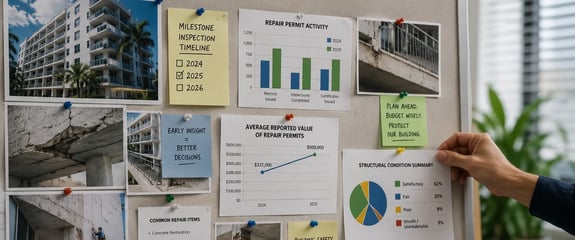
Across 2024 and 2025, Milestone Inspections resulted in 903 repair permit applications, meaning hundreds of buildings required repair work after engineers assessed their structural condition. In addition, 54 buildings were reported as unsafe or uninhabitable.
Those numbers aren’t intended to create fear.
To us, they’re evidence that the Milestone Inspection process is doing exactly what it was designed to do: identifying structural issues that need attention before they have the opportunity to become something much more serious.
That’s why we don’t see Milestone Inspections as a compliance exercise. They’re about understanding the condition of a building, protecting the people who live there, and giving associations the opportunity to make informed decisions before problems escalate.
Insight #2: Waiting doesn’t make building repairs less expensive.
When Florida first introduced the new Milestone Inspection requirements, boards and property managers wanted to understand everything.
Does our building require a Milestone Inspection? What does the inspection involve? Will residents be disrupted? What happens if the engineer finds structural issues?
Those were the questions we were answering every day.
Today, we hear them much less often. The first wave of deadlines has passed, and for many associations, the sense of urgency has eased. If your association hasn’t received an official notice yet, it’s easy to think there’s still plenty of time.
What hasn’t eased, however, is the financial impact of maintaining aging buildings.
One figure in Florida’s latest Milestone Inspection reporting data immediately caught our attention: the average reported value of repair permits increased from approximately $337,000 in 2024 to nearly $500,000 in 2025.
Of course, every building is different. The condition of a building, its maintenance history, location, and the type of repairs needed all influence the final cost. The report doesn’t tell us why the average repair value increased, and it’s important not to jump to conclusions.
What it does reinforce is something we’ve been telling boards for years: the earlier you understand your building’s structural condition, the more flexibility you have to prioritize repairs, budget appropriately, and respond before small issues become larger ones.
Insight #3: Don’t Mistake a Quieter Conversation for a Quieter Reality.
One thing we found particularly interesting is that Florida’s statewide Milestone Inspection data is still incomplete.
Not every city and county has reported its inspection data to the state, and OPPAGA itself acknowledges limitations in the current reporting process. In other words, the statewide numbers don’t yet tell the complete story of what’s happening across Florida.
To us, that’s an important reminder.
The responsibility to understand your building’s Milestone Inspection requirements doesn’t depend on your municipality having a well-established reporting and communication process.
Different cities are at different stages of implementing and communicating their local programs. Some have dedicated webpages, clear timelines, and established procedures. Others are still refining their processes.
That’s why we encourage boards not to wait until everything feels perfectly clear before starting the conversation. Taking ownership early puts your association in a stronger position, regardless of how quickly your municipality’s processes continue to evolve.
So, what should boards take away from this?
Florida’s latest Milestone Inspection reporting data doesn’t change the law, introduce new requirements, or tell us what every building will need.
What it does provide is a valuable snapshot of where Florida stands today.
To us, three things are clear:
- Milestone Inspections are identifying buildings that need attention.
- The financial impact of repairs is significant and keeps increasing over time.
- And while reporting and implementation continue to evolve across the state, the responsibility to understand your own building remains the same.
That’s why we believe the most successful associations won’t be the ones that simply react when an official notice arrives. They’ll be the ones that stay informed, ask questions early, and take ownership of understanding their building’s condition.
Ultimately, that’s what Milestone Inspections have always been about: not just complying with a requirement, but helping boards protect their buildings, their finances, and the people who call them home.
Is your building’s Milestone Inspection approaching? Learn what to expect, how the process works, and how to prepare in our Florida Milestone Inspection Guide.
Learn More About Milestone Inspections and Building Safety
Campbell Property Management regularly hosts educational webinars related to milestone inspections, building safety, structural repairs, reserve planning, engineering issues, and other topics affecting Florida condominium associations. Visit CampbellEvents.org for upcoming educational opportunities and events.
Scott Harvey-Lewis is the visionary President and owner of Building Mavens, a preeminent Milestone Inspections and Engineering Consulting Firm based in the heart of Palm Beach Gardens, Florida. As a licensed professional engineer with over a decade of experience and nearly two decades of dedicated engineering expertise, he is exceptionally qualified in delivering a comprehensive suite of services in structural engineering, including design, construction, administration, and forensic analysis, catering to clients and projects across the public and private sectors.