FL Statute 558 Webinar
When a new community changes hands from its developer, the Florida Statute 558 construction defect process gives a board its first structured opportunity to confirm what was built correctly and what was not. We recently hosted a CEU course featuring Ben Messerschmidt of Epic Forensics & Engineering, who guided licensed community association managers and board members through how this pre-suit process works from start to finish.
This educational webinar traced the full arc of a Statute 558 matter, from the records a board should gather at turnover through the property condition assessment, the written notice of claim, the developer's inspection and response window, and the routes that lead toward resolution.
Disclaimer: This video is for educational purposes only. You will not receive credits for watching the recording. Credits were issued only to those that attended the course.
If you enjoyed this video, check out our YouTube channel and subscribe to view all of our educational videos relating to community association management in Florida.
Key Takeaways
-
A Process, Not an Event: Statute 558 unfolds over months or even years rather than on a single fixed deadline, and it is optional, giving a board a structured way to pursue resolution before any lawsuit is filed.
-
Turnover Documents Decide Outcomes: As-built drawings, certificates of occupancy, warranties, and the structural reserve study gathered at turnover form the factual backbone every construction defect claim later depends on.
-
The Notice Starts the Clock: Served on the developer and related parties, the written notice of claim must go out at least 60 days before a lawsuit, or 120 days for associations of more than 20 parcels.
-
Causation Carries the Case: Proving why a defect occurred, often through destructive testing, matters far more than showing that something merely failed, since these are evidentiary, expert-driven matters.
What Is the Florida Statute 558 Process?
A Pre-Suit Path to Resolution
Florida Statute 558 is a pre-suit process that lets an association formally raise construction defects with a developer and its contractors before filing a lawsuit. Written into law about twenty-five years ago, it was designed as a way to reach resolution through inspection, response, and negotiation rather than immediate litigation. The word process matters, since a 558 matter rarely follows a quick or rigid timeline and can span anywhere from several months to several years. It is also entirely optional, which means a board can treat it as a disciplined starting point and decide at each stage how far to take it.
How 558 Works With Statutes 718 and 720
Formally cited as Chapter 558 of the Florida Statutes, the construction defect law works alongside the statutes that govern how a community is created. Statute 718 applies to condominiums and Statute 720 applies to property and homeowners' associations, and both outline the documentation and steps required to complete turnover, the transfer of ownership from a developer to the association. Once that transfer occurs, the association can begin its own due diligence into the building's condition, and the 558 process is the framework for doing so. Seeing where these statutes connect helps a board treat the 558 study not as an isolated report but as the moment it takes true ownership of the property's condition.
Documents to Secure at Turnover
What Turnover Really Transfers
Turnover is the point at which control of a community shifts from the developer to the owners, usually once roughly ninety percent of the units have sold and the required paperwork is complete. At that stage the association should receive a formal release or transmittal confirming that everything owed under the governing statutes has been handed over. Some items tend to arrive later than others, so a board should track what is still outstanding rather than assume the package is complete. Confirming that nothing is missing early on protects the association's ability to investigate the building later.
The Records That Carry the Most Weight
A handful of documents matter more than the rest when a construction defect claim is on the horizon. The as-built or record set of construction drawings shows how the building was intended to be built, the certificates of occupancy confirm the space can be legally used, and the written warranties reveal who stands behind the work, even if many carry only short terms. Recent Florida law also adds the structural integrity reserve study to the turnover package for qualifying buildings, which a developer must complete before handing the community over. Shop drawings for systems such as glazing, railings, and post-tensioning, along with the recorded declaration, the vendor list, and the technical specifications, round out the records an engineer relies on to understand what should have been there.
Turning Observations Into a Notice of Claim
The Role of the Notice of Claim
A written notice of claim is the document that formally places the developer and its contractors on notice that a problem on the property needs attention or, at minimum, a response. It is a notice-style report rather than a demand, and its original purpose is to open the door to a resolution before anyone files suit. The notice describes each suspected defect clearly enough that the responding parties can locate and evaluate it for themselves. Getting this document right sets the tone for everything that follows, because the opposing side has the right to review each item it raises.
Assessing the Property's Condition
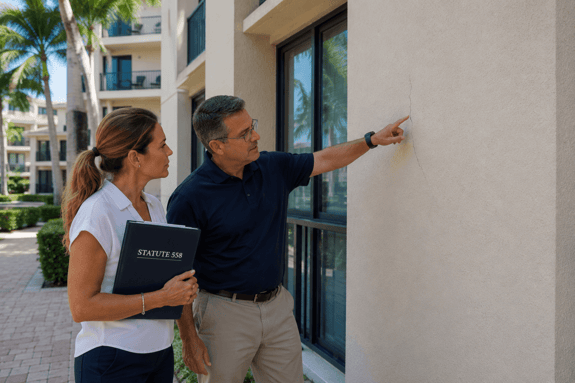
Behind every notice of claim is a property condition assessment carried out by an engineer following recognized standards such as ASTM E2018. The goal is a property condition report that captures defects reasonably tied to the original construction, not the routine or deferred maintenance that any building accumulates over time. Much of the work begins before anyone sets foot on site, drawing on the turnover documents, interviews with the property manager and long-serving staff, and even a questionnaire for unit owners. Owners do not need to diagnose anything themselves, since simply pointing to where a problem appears gives the engineering team a lead worth chasing down. These evaluations are still only snapshots in time, so the people who live with the building every day remain an essential source of insight.
“We're attempting to go ahead and recreate a two-car accident, knowing that the best-case scenario, we're only going to be able to have access to one of those cars.” - Ben Messerschmidt, Epic Forensics & Engineering
Inside the Property Condition Report
Common Elements, Not Individual Units
A 558 assessment concentrates on the parts of a property the association is responsible for, meaning the infrastructure and shared components rather than the customized finishes inside any one unit. Slabs, balconies, railings, fire suppression systems, and common areas all fall within its scope, and a problem inside a single unit is generally included only when the same mistake repeats across the building and becomes a common element. On large properties an engineer reviews a representative sample rather than every square foot, both to control cost and to keep the study from becoming an obstacle to doing it at all. Industry standards guide how much of a property must be examined for that sample to produce reliable data.
The Questions Every Finding Answers
Each entry in a property condition report answers a consistent set of questions so that anyone can follow it. It records where the defect sits precisely enough to be found again, what the condition actually is, and who or which trade may be responsible. It then explains why the item qualifies as a defect, whether that is a building code violation, a deviation from the approved plans, or a failure to meet an accepted industry standard. The how, meaning the repair approach and its cost, often comes later, since answering it can require further testing rather than a simple visual review. Presenting these findings in a clear, photo-supported format keeps the eventual conversation with the opposing side grounded in fact rather than opinion.
Notices, Responses, and Timelines
The Notice and Response Timeline
The statutory clock is what turns a finished report into a formal claim. Once the signed and sealed report is served through counsel, the initial notice of claim must go out at least 60 days before a lawsuit, or 120 days when the claim involves an association of more than twenty parcels, which covers most communities. The parties who receive it then have a defined window, generally around thirty days and up to fifty for larger associations, to inspect the property and provide a written response. Construction defect response timelines can stretch further in practice, because these properties are dynamic and new failures during a rainy season often call for a supplemental report.
Weighing the Developer's Response
After a report is served, the responding parties are entitled to a walkthrough where they can examine every location it identifies, an event that might involve a single representative or dozens of people across several days. Their response can take several forms, from an offer to repair or pay for repairs to a flat denial or a claim that the work fell to a different subcontractor. Even a response that points to another party is useful, since it moves the association closer to identifying who is truly accountable. When an offer to repair does arrive, the association is wise to insist on a written commitment to fix the defect at no cost and an approved repair protocol signed off by its own professional rather than a quick patch.
Proving Causation Through Destructive Testing
Peeling Back the Layers
When a matter grows serious or heads toward a lawsuit, the case becomes evidentiary and expert-driven, and proving the cause of a defect becomes the central task. Many of the most important failures are hidden, so confirming why they happened means removing finishes and opening up assemblies to see what lies beneath. The opposing side must be notified before any destructive work, with a date and scope provided, and is welcome to attend and observe. This stage is where a visible symptom is finally connected to its underlying cause.
Common Tests and What They Reveal
A facade evaluation on a high-rise often exposes how corrosion takes hold, as chlorides in salt-laden air reach reinforcing steel that lacks enough concrete cover, causing it to rust, expand, and push the surrounding material apart. That same sequence explains many of the cracks and concrete restoration projects that older coastal buildings eventually face. Water intrusion is tested by building a chamber that sprays and draws air across a window assembly to see whether water crosses to the interior, while stacked bathrooms are checked with shower pan and flood tests that reveal leaks a visual review would miss. On the HOA side, pavement coring answers why a surface is cracking or settling by revealing the materials, compaction, and water table beneath a Florida community's roads.
“This is where a spall develops, how an innocent crack becomes a spall.” - Ben Messerschmidt, Epic Forensics & Engineering
Paths to a Resolution
Technical Meetings and Mediation
Most 558 matters are resolved long before a courtroom is involved. Technical meetings, sometimes called a meeting of the experts, bring both sides' professionals together to compare findings and narrow the list of disputed items over one or more sessions. Mediation adds a neutral facilitator and often proves more productive once a lawsuit gives the developer's insurers a reason to engage, gathering all parties and their counsel to settle some or all of the defects. Many cases close during these sessions, whether on the first day or the fourth.
Depositions, Trial, and Settlement
When disputes remain, experts give depositions under oath, where their qualifications, methods, and conclusions are recorded and later relied upon. Trials are rare, and most claims settle before reaching one, but an expert who does testify must defend the report's accuracy under cross-examination. A settlement is then signed by all relevant parties and can take almost any form, from funded repairs to monetary payments or other negotiated terms. These agreements usually release all latent defects, meaning the hidden problems as well, so the community and the developer parties can close the matter for good.
“This is an optional process. So, you can get off the carousel whenever you want to get off the carousel.” - Ben Messerschmidt, Epic Forensics & Engineering
Treating 558 as a Long-Term Safeguard
The Statute 558 process rewards associations that treat it as disciplined due diligence rather than a last resort. A board that gathers the right documents at turnover, commissions a thorough condition assessment, respects the statutory timelines, and leans on qualified professionals gives itself the strongest possible footing, whether the matter resolves in a few months or unfolds over several years. Return on investment belongs in the conversation at every stage, since the process carries real costs and each community's circumstances differ. Approached with clear records and sound guidance, a construction defect claim stops being a source of dread and becomes a measured way to protect a building's safety, its finances, and the value every owner is counting on.
Frequently Asked Questions
Can we make repairs while a Statute 558 claim is still open?
Yes, but notify your engineer, your counsel, and the responsible parties before the work begins. A 558 matter can take years, and an active problem like water intrusion cannot wait, so placing everyone on notice first protects your claim and prevents a party from later arguing it was denied the chance to make the repair itself.
How long does the Statute 558 process usually take?
It can run anywhere from about six months to six years. The length depends on how many parties are involved, how many repairs are underway, and how much destructive investigation is needed to establish the cause, which is also why cost and return on investment stay part of the discussion throughout.
Does Statute 558 apply to a capital improvement project or only to new construction?
It applies to both. A defective restoration or renovation, such as a pool deck, clubhouse, or roof that misses the mark and cannot be resolved with the contractor, can move through the same 558 process that follows a new building's turnover.
Explore our blog for expert insights, current industry updates, helpful resources, and takeaways from our educational webinars.
Ashley Dietz is the VP of Marketing at Campbell Property Management and has led the company’s educational and marketing initiatives since 2013. A Florida Atlantic University graduate with a bachelor’s degree in communications, Ashley specializes in community association education, digital outreach, and industry engagement for Florida HOAs and condominiums.