Managing Trip Hazards Webinar
Addressing HOA trip hazards is an essential responsibility for Florida community associations to help maintain property safety and value. To provide community leaders with actionable insights, we recently hosted an educational CEU course featuring industry expert Robert DiMattina from Trip Hazard 911, who discussed identifying sidewalk trip hazards and implementing effective liability prevention strategies. This webinar session highlighted practical maintenance best practices, the legal definitions of hazards, and the importance of proactive property inspections.
Understanding the risks associated with uneven walkways allows association leadership to address issues before they become costly legal liabilities. By prioritizing regular assessments and selecting the right remediation methods, condo and HOA boards can ensure the structural integrity of their common areas and protect the community's financial health for years to come.
Disclaimer: This video is for educational purposes only. You will not receive credits for watching the recording. Credits were issued only to those that attended the course.
If you enjoyed this video, check out our YouTube channel and subscribe to view all of our educational videos relating to community association management in Florida.
Key Takeaways
-
Legal Standard: The Americans with Disabilities Act (ADA) defines a trip hazard as any vertical change of a quarter-inch or greater, a standard that often serves as the benchmark for negligence in legal disputes.
-
Proactive Prevention: The cost of a proactive repair is significantly lower than the potential expenses of a single trip-and-fall claim, which can range from $50,000 to over $5 million.
-
Common Culprits: Tree root growth, soil settlement, and erosion are the primary drivers of sidewalk displacement, often creating hazards that blend into the environment over time.
-
Shared Responsibility: Liability for trip hazards can be shared among property owners, HOA boards, and management teams, making clear documentation and timely repairs essential for a strong legal defense.
What Legally Defines a Trip Hazard in Florida Communities?
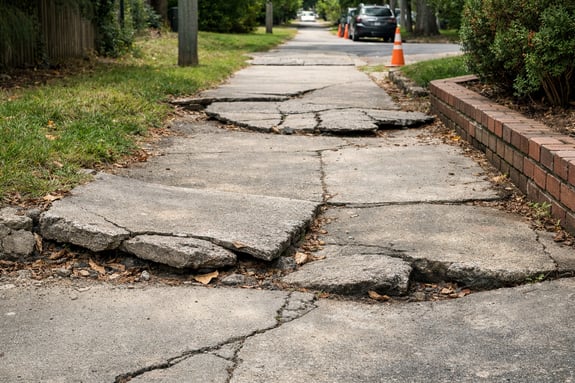
In the eyes of the law and the Americans with Disabilities Act (ADA), a trip hazard is defined as a vertical change of 1/4 inch or greater at any joint or crack. While some service providers may only focus on hazards of 1/2 inch or more to reduce immediate costs, ignoring smaller displacements can leave an association vulnerable. These minor shifts are often the most dangerous because they are "reasonably discoverable" but frequently overlooked by residents and staff until an accident occurs.
For community management, understanding this threshold is vital for risk mitigation. Even in private communities where strict ADA compliance might be debated, courts often look to these standards to determine if an association met its fiduciary duty to maintain a safe environment. Failing to address a known quarter-inch displacement can be viewed as gross negligence, significantly weakening the community's position in a legal liability dispute.
"A trip hazard is defined by the ADA as a vertical change of a quarter of an inch or greater. It doesn't have to look dangerous to be legally considered a hazard and create liability." - Robert DiMattina, Trip Hazard 911
Identifying and Addressing Common Sidewalk Hazards
The Impact of Tree Roots and Soil Movement
One of the most frequent causes of sidewalk displacement in Florida is tree root growth. As roots expand, they exert tremendous upward pressure on concrete slabs, leading to gradual elevation changes and structural cracking. This type of tree root damage is a recurring issue that requires ongoing monitoring to prevent minor shifts from becoming major safety risks.
Beyond roots, soil settlement and erosion play a significant role in compromising walkway stability. When soil washes out from beneath a panel, it creates voids that cause the concrete to sink or tilt. What appears as a simple surface issue is often a symptom of underlying drainage problems. Addressing these concerns through proper road and driveway maintenance ensures that the entire pedestrian network remains stable and safe for all residents.
Remediation vs. Replacement Strategies
When hazards are identified, community leaders must choose between traditional replacement and modern remediation techniques. While replacing entire concrete panels is sometimes necessary for severe damage, it is often the most expensive and disruptive option. Precision concrete cutting or grinding can often eliminate trip hazards by creating a smooth, ADA-compliant transition between uneven slabs at a fraction of the cost.
For management teams, the speed of repair is a critical factor in liability prevention. A small repair completed within a few weeks of discovery is a much stronger defense than a deferred project that remains on a "to-do" list for months. Proactive parking lot liability reduction and sidewalk maintenance are the most effective ways to avoid the documentation gaps that often lead to unfavorable legal outcomes.
"Deferred maintenance is one of the fastest ways to turn a minor issue into a major liability. Delays equal documentation gaps, and gaps equal weaker legal defense." - Robert DiMattina, Trip Hazard 911
The Financial Reality of Trip and Fall Claims
The financial exposure from a single trip-and-fall incident can be devastating for an association's budget. Beyond immediate medical bills and legal fees, a successful claim can lead to significantly increased insurance premiums and long-term financial strain. In South Florida's litigious environment, settlements often reach hundreds of thousands of dollars, far exceeding the cost of a comprehensive property-wide inspection and repair program.
Implementing a consistent inspection schedule and requiring workers' compensation from all vendors are essential steps in a broader safety strategy. By documenting every inspection and repair, boards can demonstrate a proactive commitment to resident safety. This level of diligence is the best protection against the enormous financial risks associated with unmanaged property hazards.
Frequently Asked Questions
Who is responsible for sidewalk repairs in an HOA?
Responsibility typically depends on the association's governing documents. In many cases, the HOA is responsible for common area sidewalks, while homeowners may be responsible for their individual driveways. However, the association often maintains the authority to require repairs to ensure overall community safety.
How quickly should a trip hazard be repaired once identified?
While there is no single legal deadline, repairs should ideally be completed within a reasonable timeframe, often cited as 30 days. If a contractor cannot perform the work quickly, it is advisable to seek an alternative provider to minimize the window of liability exposure.
Stay connected with Florida Association News (FAN) for the latest community association updates, educational resources, industry insights, and upcoming webinars.
Ashley Dietz is the VP of Marketing at Campbell Property Management and has led the company’s educational and marketing initiatives since 2013. A Florida Atlantic University graduate with a bachelor’s degree in communications, Ashley specializes in community association education, digital outreach, and industry engagement for Florida HOAs and condominiums.