

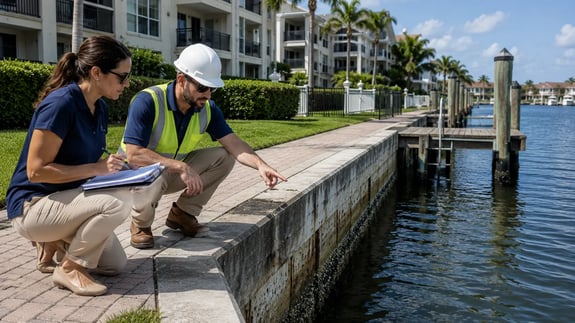
Marine Structures Webinar
For waterfront communities across Florida, well-maintained marine structures are what stand between a property and the constant pressure of wave action, erosion, and storm surge. We recently hosted a CEU course featuring industry professional Jillian Churik from Epic Forensics & Engineering, who walked community leaders through how these coastal defenses are built, regulated, and maintained.
This insightful webinar examined the full range of marine structures, from seawalls and bulkheads to revetments, breakwaters, and docks. It broke down a seawall's core parts, the standards that govern them, and the inspections and repairs that keep them sound. Board members and property managers came away with a clear way to spot early warning signs before small defects become costly failures.
Disclaimer: This video is for educational purposes only. You will not receive credits for watching the recording. Credits were issued only to those that attended the course.
If you enjoyed this video, check out our YouTube channel and subscribe to view all of our educational videos relating to community association management in Florida.
Key Takeaways
-
Different Structures, Different Jobs: Seawalls, bulkheads, and revetments hold the shoreline and fight erosion; breakwaters sit offshore to soften incoming waves, and docks provide vessel access alongside those protective structures.
-
A Seawall Is One System: Panels, piles, a connecting cap, and a mostly hidden anchoring system all work together, though not every wall includes every component or the same materials.
-
Inspections Match the Purpose: Routine reviews may run anywhere from every six months to every six years, while Level 1 through Level 3 inspections range from a broad swim-by to detailed, sometimes destructive, testing.
-
Trouble Concentrates at the Waterline: Cracks, rust stains, spalls, and soil washout gather where wetting, drying, and wave action meet, so catching them early prevents anchor failure and wall overturning.
What Are Marine Structures?
Marine structures are the coastal defenses that keep waterfront soil in place and shield property from the water’s constant force. The most common types in condo and HOA residential communities are seawalls, bulkheads, and revetments, all of which sit immediately along the shoreline to resist erosion. Seawalls are built to stand up to direct wave action, while bulkheads are so similar that the terms are often used interchangeably, though bulkheads are generally reserved for calmer settings such as canals and lakes. Revetments take a different approach, using sloped, stacked boulders that absorb wave energy rather than deflecting it.
Two other structures round out the picture. Breakwaters are positioned offshore and are designed to break up wave energy before it reaches land, softening the impact on the soil behind them. Docks serve a different purpose entirely, providing space for boats and vessels rather than stabilizing the shoreline, yet they are often found immediately beside seawalls and can be affected when major repairs take place. Since seawalls and bulkheads appear most often at residential properties, they tend to deserve the closest attention.
Anatomy of a Seawall
Panels, Piles, and Caps
A seawall works as one connected system, though only part is visible from land. The panel, or face of the wall, holds back the soil and deflects waves, and can be concrete, coral rock, steel or aluminum sheet, vinyl, or timber. Piles act like columns in the water, usually precast concrete driven into the ground to support the panels. The cap sits on top, tying the piles and panels together and providing a walkable surface out to the docks.
Anchors and Accessories
Behind the wall, a buried anchoring system resists the soil pushing outward, usually a deadman anchor or helical piles driven from the water side. Piles come in two forms: vertical king piles and angled batter piles. Accessories matter too, with weep holes relieving rainwater pressure, check valves managing tidal flow, and riprap or a toe wall guarding the base. Not every seawall has all of these, but recognizing them helps boards know what they are seeing.
“A little trick is that if it has a batter pile, it was likely repaired or restored at some point in time because the batter piles can add additional support to the wall when the anchors are disrupted.” - Jillian Churik, Epic Forensics & Engineering
Standards That Govern Seawalls
Seawalls are not covered by a single dedicated code, but they are far from unregulated. The Florida Building Code sets general rules for concrete, steel, and timber, plus access requirements for docks at public sites. Municipalities add their own rules, and with sea level rise, some now require greater heights, usually tied to a major repair. In Miami, DERM reviews environmental impact, and its permitting, once well beyond nine months, is now capped at ninety days.
Engineering standards fill in the detail. The Army Corps of Engineers offers the most comprehensive guidance on seawalls and coastal structures. ACI 318 sets minimum requirements for concrete, with stricter coverage and crack tolerances for saltwater environments. For engineers, ASCE Manual of Practice 130 defines the types of inspections, their frequencies, and the effort each requires.
Inspection Types and Levels
Matching the Inspection to the Need
The reason for an inspection shapes how it is done. Routine inspections are most common, recommended anywhere from every six months to every six years, depending on location and condition. Others are tied to specific moments: a baseline survey at turnover, a review before a repair, or a post-event check after a hurricane or failure. A licensed engineer at these points helps confirm the work matches the plans.
The Three Levels of Effort
Inspections also vary in depth. A Level 1 is a broad swim-by that covers the whole wall and catches major deterioration, which concentrates in the tidal or splash zone. A Level 2 removes marine growth and coatings across a representative area to find hidden defects. A Level 3 is the most thorough, sometimes using destructive testing, and is reserved for known or suspected problems.
Common Defects and Repairs
Walls, Panels, and Piles
Most defects appear in the tidal zone and share common fixes. A narrow crack with no rust can be routed and sealed, while a wider one that lets soil escape may mean replacing the panel, often by removing the cap and setting a new panel in front. Rust stains usually mean water has reached the steel, calling for chipping the concrete, treating the reinforcement, and patching.
Piles show the same cracking, rust, and spalling as panels and can be repaired in sections rather than by replacing the whole wall. Steel sheet panels corrode instead, and if the loss is limited, they can be cleaned and coated. Washout is a special concern: water finds a void and carries soil back out, leaving telltale divots in the ground above.
Anchors, Caps, and Docks
The cap is the easiest part to monitor, and its cracks are routed and sealed or protected with a sealer or waterproofing. Tieback and deadman anchor failures are far more serious, since these hidden parts resist the soil; when they fail, a panel can shift forward and overturn into the water. Warning signs include a slight lean or heavy cracking in the cap. Docks add their own issues, from corroding hurricane strapping to wood pilings that rot faster with marine growth, often addressed with plastic piling jackets.
“The main purpose of a seawall is to go ahead and stabilize the soil and retain the soil on the property. So, washout is the exact opposite. It’s finding some sort of void within the seawall itself, and it is just taking the water and bringing it back to the ocean.” - Jillian Churik, Epic Forensics & Engineering
Frequently Asked Questions
How well do anchors hold in loose, sandy soil?
An engineer accounts for soil conditions in the original design, setting deadman anchors well back and deep enough to hold. Those calculations let the anchors perform even in loose sand.
Rust keeps bleeding through a waterproof-coated cap. What went wrong?
It usually means water has already reached the reinforcement, so the coating alone will not fix it. The steel must be cleaned and treated before the product is reapplied.
Can a seawall cap be sloped to shed standing water?
A very slight grade is possible, but it must stay minimal since the cap is walked on. A pronounced slope is rarely used.
Explore our blog for practical community management guidance, industry updates, helpful resources, and webinar recaps.
Ashley Dietz is the VP of Marketing at Campbell Property Management and has led the company’s educational and marketing initiatives since 2013. A Florida Atlantic University graduate with a bachelor’s degree in communications, Ashley specializes in community association education, digital outreach, and industry engagement for Florida HOAs and condominiums.