

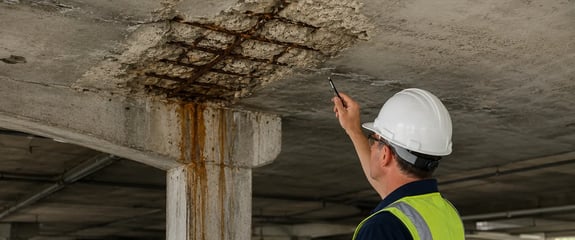
A parking garage may require more than routine maintenance when warning signs like rust staining, concrete spalling, structural cracking, failed expansion joints, or deteriorating prior repairs begin to appear. For condominium and HOA communities, identifying these issues early through engineering evaluations can help prevent costly structural rehabilitation, emergency repairs, and potential safety hazards.
Key Takeaways:
- Rust staining may indicate active reinforcement corrosion inside the concrete.
- Spalling concrete and hollow-sounding slabs can become life-safety concerns.
- Certain crack patterns may signal structural distress requiring engineer review.
- Failed expansion joints often allow water intrusion that damages structural slabs.
- Deteriorating prior repairs may indicate unresolved systemic problems.
Why Are Parking Garages So Vulnerable to Concrete Deterioration?
Parking structures are among the most environmentally aggressive settings a concrete building will experience. Exposure to rainwater, humidity, vehicle-tracked chlorides from deicing salts, and repeated thermal cycling creates conditions that accelerate deterioration far faster than a typical above-grade residential building. For community associations, the garage is one of the most expensive single line item in a restoration budget — and the most under-monitored until parking garage deterioration is already advanced.
Recognizing early warning signs can be the difference between a targeted repair project and a full structural rehabilitation. Associations looking to better understand the restoration process can also explore this condo repair and restoration webinar.
Here are five conditions that warrant an immediate engineering evaluation:
What Does Rust Staining on Concrete Surfaces Mean?
Brown or orange staining on slabs, columns, or beams is not a cosmetic issue — it is a symptom of potential structural concrete damage. Rust stains can indicate that embedded reinforcement have begun to corrode, and chloride-laden water has found a path through the concrete cover. By the time staining is visible, corrosion is already underway and section loss of the steel may have begun. This warrants a Phase 1 assessment at minimum, including sounding surveys and targeted chloride sampling.
Why Is Spalling or Delaminating Concrete a Serious Concern?
Chunks of concrete falling from overhead surfaces are a life-safety concern, not just a maintenance issue. Delamination can occur when corroding rebar expands, fracturing the concrete cover from within.
When Concrete Deterioration Becomes a Life-Safety Issue
Any area where concrete sounds hollow under a hammer tap should be mapped, monitored, and evaluated for near-term repair. Areas above pedestrian paths or parked vehicles require immediate temporary protection.
When Should Cracks in Parking Garage Slabs or Beams Be Evaluated?
Not all cracks associated with parking garage maintenance concerns are equal. Narrow, dormant shrinkage cracks are generally benign. Wide, active, or pattern-cracking may indicate structural distress and warrants prompt engineer review. Width, orientation, activity, and location all matter in making that determination.
Why Are Expansion Joints and Sealants So Important in Parking Garages?
Expansion joints and traffic-bearing sealants are the garage's first line of defense against water infiltration. Failed sealants allow water and chlorides to migrate directly to the structural slab below.
How Failed Sealants Lead to Structural Slab Damage
Because this deterioration is easy to overlook during routine walkthroughs, it is frequently deferred until the slab beneath has already sustained damage. Proactive joint maintenance is far less expensive than the slab repairs that follow neglect.
What Can Failed Previous Repairs Reveal About a Parking Structure?
Failed previous repairs are a telling indicator of systemic problems. If patch repairs are cracking, popping off, or showing rust bleed-through within a few years of installation, the root cause may not have been properly addressed. An engineer should evaluate whether the existing repair methodology is appropriate before additional money is spent repeating it.
When Should Associations Schedule a Parking Garage Engineering Assessment?
Parking garages do not fail suddenly — they communicate distress gradually through these visible signs. A periodic engineering assessment every 3 to 5 years, or immediately upon observing any of the above conditions, allows the Association to plan and budget for restoration work before it becomes urgent, expensive, or unsafe.
Ben Messerschmidt, P.E., is a COO and forensic engineer at Epic Forensics & Engineering, Inc., specializing in milestone inspections, defect analysis and restorative design, condition assessments, expert representation, and consulting. A client advocate and industry leader serving community associations and complex infrastructure projects with insight, precision, and integrity.