

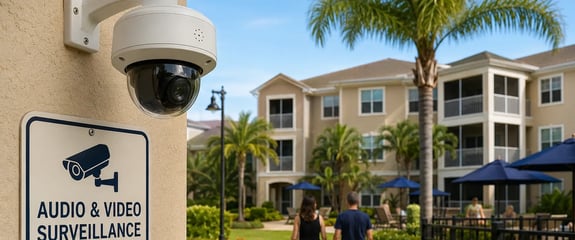
Florida community associations using audio-enabled surveillance systems must comply with strict two-party consent laws, privacy protections, and notification requirements. HOA and condominium boards should carefully evaluate where audio recording is permitted, when consent is required, and how signage, policies, and governing documents can help reduce legal exposure.
Key Takeaways:
- Florida is a two-party consent state for audio recordings.
- Privacy expectations vary depending on the location being recorded.
- Clear signage may help establish implied consent in common areas.
- Audio recording should never occur in areas with heightened privacy expectations.
- Associations should adopt clear retention and recording policies for surveillance footage.
What Legal Risks Do Associations Face With Audio and Video Recording?
Florida Community associations increasingly rely on surveillance technology to enhance safety and protect property. Cameras with embedded microphones are everywhere these days. As systems become more sophisticated, many boards are considering or are already using audio-enabled cameras in common areas. However, in Florida, recording spoken conversations raises significant legal considerations. This is especially true in areas where a reasonable person would think their conversations are private. Associations must navigate stringent consent laws, privacy expectations, and specific notification requirements to remain compliant and avoid liability. This article summarizes Florida’s legal framework governing audio recordings and outlines best practices for boards seeking to implement or update their surveillance programs.
Florida is a two-party consent state, meaning that all parties to a private conversation must consent before they can legally be recorded. This rule applies to in-person, telephone, and electronic communications. Florida Statute §934.03(1)(d) is explicit and specifically states: “It is lawful…for a person to intercept a wire, oral, or electronic communication when all of the parties to the communication have given prior consent.” Because audio recording captures oral communication, compliance with this statute is essential. Failure to obtain proper consent can expose the association to civil and criminal liability.
When Do Residents Have a Reasonable Expectation of Privacy?
A person’s “consent” depends on whether an individual has a reasonable expectation of privacy in the area where the audio recording takes place. Florida law generally holds that there is no expectation of privacy in public settings where conversations can reasonably be overheard.
A reasonable expectation of privacy does exists in the following places:
-
Private residences
-
Owners’ backyards
-
Restrooms or changing areas
-
Any non-common-area spaces
-
Common area spaces such as in the manager’s office
Thus, common areas such as fitness centers, social rooms, and pool decks may be recorded but only if proper consent is secured. However, associations should exercise caution. Even within common areas, certain locations (e.g., tot rooms or pool changing areas) may introduce heightened privacy or liability concerns, most especially when involving minors.
In a 1996 case, Stevenson v. State of Florida, 667 So.2d 410 (1st DCA 1996), the court found that a defendant had no reasonable expectation of privacy during a conversation held outside a van parked on a public roadway in a known drug‑trafficking area. Because the exchange occurred in plain view and under circumstances strongly indicative of a drug transaction, the intercepted remarks suggesting criminal activity did not qualify as protected “oral communication” under state laws governing the security of communications. Under those statutes, a conversation is protected only when the speaker both subjectively expects privacy and that expectation is one society is prepared to recognize as reasonable. The court concluded that neither condition was met, noting that the individuals took no steps to shield their discussion from public exposure.
Why Is Clear Signage Important for Audio Surveillance Compliance?
Associations should rely on Florida law, which recognizes “implied consent” when recording devices are installed in a manner that is “clearly and immediately obvious.” Under Florida Statute §810.145(5)(c), obvious placement of recording equipment, coupled with clear written and posted notices, reduces privacy expectations.
Where Should Associations Place Surveillance Signage?
To rely on implied consent, associations should use large, conspicuous signage at every amenity, every interior location, and every area where audio recording occurs, such as the following:
-
The entrance to any area with audio recording, such as the clubhouse entrance
-
Inside the area itself, such as in the manager’s office and the club rooms
-
Place the signage at eye-level locations where visibility is guaranteed.
What Language Should Surveillance Signs Include?
Suggested language of the posted signs would be something on the lines of: “This area is under video and audio surveillance. Your presence constitutes implied consent to being recorded.” A single sign at the community entrance is most likely not sufficient.
Should Associations Obtain Written Consent for Recording?
While signage may be adequate for implied consent, written consent provides the strongest legal protection. Associations may want to offer the following:
-
Provide acknowledgment forms to all residents, tenants, employees, and vendors. However, the association cannot force an owner to execute it.
-
Incorporate consent forms into onboarding packets for new members.
-
Update governing documents such as the declaration to include a provision that audio and video recording is taking place or include such a provision into the rules and regulations. (Remember, too, provisions within the declaration have a higher presumptive degree of validity).
However, obtaining 100 percent participation may be difficult, which is why signage remains essential.
Where Should Associations Avoid Audio Recording Entirely?
Be advised, Florida law prohibits recording in areas where privacy expectations are inherent. Associations must not use audio-enabled cameras in the following areas:
-
bathrooms or restrooms
-
locker rooms or changing rooms
-
private staff areas
-
any non-common areas
Failure to follow these restrictions may result in significant liability.
What Best Practices Help Reduce Legal Exposure?
Best practices to minimize risk and ensure compliance require associations to consider a conservative approach that includes the following:
-
Visible cameras should be installed in obvious and open areas.
-
Conspicuous signage should be placed at entrances and inside each recorded area.
-
The association might try to obtain written consent where feasible.
- The association should avoid audio recordings (and possibly video recording pending the situation) in any area with heightened privacy expectations.
This combination reduces the likelihood of disputes and legal exposure.
Are Audio and Video Recordings Considered Official Records?
The Florida Statutes do not expressly state that audio and video recordings (excluding board and membership meetings) constitute a part of the official records of the association which must be produced in response to a member’s official record production request. Furthermore, while the statutes reference that all “written” records of the association that relate to the operation of an association are part of the official records, in our view, video/audio recordings are not “written” records as contemplated by this statutory reference. However, other attorneys may have a difference of opinion.
Until the Florida legislature amends the “official records” legislation to expressly include that all audio and video recordings are part of the association’s official records that must be provided to a requesting member upon their making of an official record request, the board has the discretion whether to provide access, and if a request is received, we recommend reaching out to the association’s lawyer for a discussion and an opinion whether access to such audio and video recordings should be provided to a member requesting them.
Why Should Associations Adopt Retention Policies for Recordings?
Notwithstanding, associations would be wise to retain and store the audio and video which memorialize any incidents that take place such as, for example, a fight on the pickleball court, a slip and fall on the sidewalk and a screaming match at a board meeting. In addition, as a part of the associations rules and regulations governing official records, the association should have clear policies on audio video storage retention so that the community is on notice that these recordings will only be available for a limited window of time.
What Are the Rules for Recording Electronic Board Meetings?
Pursuant to §718.112 Fla. Stat., a Florida condominium board meeting which takes place via video conference must be recorded, and the recording is a part of the official records of the association, where the notice of meeting must provide that the video option is available, and such notice must include a link to join the meeting by telephone access as well as a physical location for in-person attendance. The relevant legislation requires that this recording be maintained as an official record for at least one year and that such meeting video must be posted on the association’s website, or at least a link to the meeting is required. If the meeting is held only in person, then there is no requirement for recording of such meeting; however, members are free to record at member and board meetings, though the association is certainly able to promulgate reasonable rules and regulations governing such activity.
Additionally, associations should also stay informed about Florida’s evolving video-meeting requirements for condominium associations.
A homeowners’ association subject to chapter 720 Florida Statutes does not, at least at this time, mirror Chapter 718 when it comes to recording of electronic meetings. There are no requirements that the electronic board or member meeting must be recorded, and there is no requirement that a meetings’ recording must be posted to the association’s website. Rather, the homeowners’ association is required to keep minutes of all board and membership meetings and maintain them for seven years. Once again, members have the right to record such board and member meetings, and the association can promulgate reasonable rules and regulations governing such recording activity.
How Can Associations Balance Security, Privacy, and Compliance?
Audio-enabled surveillance can enhance security in community associations, but it also carries legal responsibilities. By understanding Florida’s consent requirements, adopting thorough signage practices, and avoiding recording in private areas, associations can make informed decisions that balance safety, privacy, and compliance. If your board is considering activating audio recording, these guidelines provide a solid foundation.
As always, consult with your association’s attorney for advice tailored to your specific community.
This article was adapted from “REMBAUM'S ASSOCIATION ROUNDUP | The Community Association Legal News You Can Use” by Kaye Bender Rembaum. Click here to read the article on the law firm's website.