

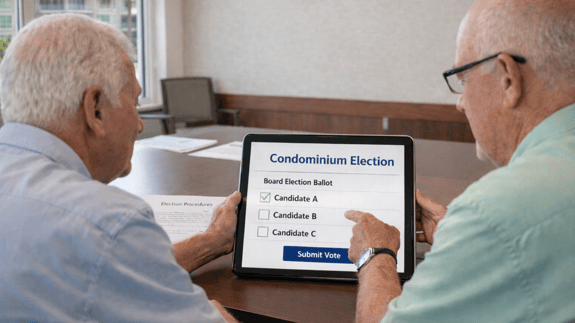
Running a Condo Election with E-Voting Webinar
Running a condo election is one of the most procedure-heavy responsibilities a Florida association takes on, and electronic voting has made the process both more accessible and more exacting. We recently hosted a continuing education course featuring Frank Valdes of GetQuorum, a licensed instructor and industry professional, who guided licensed community association managers through the statutes, deadlines, and mechanics of running a compliant condominium election.
This educational webinar focused on Chapter 718 condominiums, walking through the electronic voting statute, the House Bill 913 updates, the election notice timeline, ballot and secrecy rules, and the practical steps for merging paper and electronic votes at a single meeting.
Disclaimer: This video is for educational purposes only. You will not receive credits for watching the recording. Credits were issued only to those that attended the course.
If you enjoyed this video, check out our YouTube channel and subscribe to view all of our educational videos relating to community association management in Florida.
Key Takeaways
-
Statute Sets the Foundation: Florida's electronic voting law lets a condo board adopt e-voting by resolution, taking precedence over older governing documents.
-
Owners Opt-In by Consent: Adopting e-voting never forces participation; owners remain paper voters by default until they consent to vote electronically.
-
Notice Timelines Are Strict: Condo elections follow strict deadlines: a first notice near sixty days, and a ballot notice fourteen days out.
-
Secrecy and Quorum Still Govern: Ballots must stay secret, proxies are barred, and a valid election needs at least twenty percent participation.
How Does Electronic Voting Work in Florida Condos?
Turning On E-Voting by Resolution
Florida first authorized electronic voting in 2015 under Section 718.128 for condominiums, with parallel provisions covering cooperatives and homeowners' associations. The statute takes precedence over an association's governing documents, so a community can move forward regardless of how old its documents are or whether they mention electronic voting at all.
Adoption starts with a single step in which the board passes a resolution allowing electronic voting to be used in the community. Only the board votes on that resolution, and passing it simply activates the option. It does not require any owner to vote electronically or amend the governing documents.
Owner Consent and the Paper Default
Once the switch is on, participation is entirely up to each owner. Owners must affirmatively consent before they can vote electronically, and by default every owner is treated as a paper-based voter until they opt in. Communities that make the change are commonly seeing opt-in rates near eighty percent, which reflects how readily most owners take to the convenience.
There is a built-in pause to keep the process orderly. Electronic voting consents close roughly fourteen days before a meeting that requires a membership vote, then reopen after the meeting, which prevents last-minute opt-ins from colliding with ballots that have already been cast.
Votes That Count Toward Quorum
The largest benefit written into the statute is that an electronic vote counts toward quorum. An owner who consents and casts an e-vote is treated as participating, so they do not need to be physically present or submit an attendance proxy. That single provision is what makes electronic voting so valuable for snowbird communities and investor-owned buildings, where many owners are out of state or out of the country when the annual meeting arrives.
“If they take no action whatsoever, even after the board resolution is passed, owners remain a paper-based voter only.” - Frank Valdes, GetQuorum
What House Bill 913 Changed
Faster Adoption and Owner Petitions
House Bill 913, signed into law in July 2025, streamlined how a condominium adopts electronic voting. The old fourteen-day meeting notice for considering electronic voting is gone, replaced by a standard forty-eight-hour notice for the board meeting where the resolution is passed by majority vote.
The same law also shifted some leverage to owners. If twenty-five percent of the unit owners petition the board to adopt electronic voting within one hundred eighty days of the last annual meeting, the board must hold a meeting within twenty-one days and adopt the resolution, ensuring the option is at least available even when a board has been reluctant to act.
Records, Recordings, and the Email Ballot Option
Official records now expressly include electronic records, bank statements, and recordings of video conference meetings, so a condominium hosting virtual meetings should record each one and make the recording accessible to owners, such as through a link on the community website. When an annual meeting is held electronically, a quorum of the board must still be physically present at the location, and the meeting must be recorded.
When a condominium has not adopted electronic voting, it must instead designate an independent email address where owners can send in their secret ballots. That option comes with a tradeoff, because an owner has to identify themselves to return an email ballot, which means the vote is no longer secret. It only applies when no electronic voting provider is in place, so an association that already has one does not need to offer it.
The Condo Election Timeline
Key Notice Deadlines
Condominium elections run on a firm sequence of notices, and counting them backward from the meeting date keeps a community compliant. A notice of voting rights suspension should go out around ninety days ahead when it applies, and any decision to suspend a voter's rights belongs in that early window rather than at the last minute. The first notice of the annual meeting and election, which signals owners that an election is coming and invites candidates, is typically sent sixty days prior.
Candidates must submit their notice of intent to run at least forty days before the election, with candidate information and bios generally received around the thirty-five-day mark. The second notice, often called the ballot notice because it contains the official ballot, follows no less than fourteen days before the meeting. Owners who have consented to electronic notice delivery can receive these notices electronically, while owners without consent or an email on file must still receive a paper notice with a corresponding affidavit of delivery.
Who Can Run for the Board
Any unit owner is generally eligible to run at the time they submit a timely notice of intent, provided they have not been notified otherwise. Several categories are excluded, however, and communicating eligibility early avoids disputes at the annual meeting. Owners who owe a condominium assessment when submitting the intent notice, individuals suspended or removed by the DBPR, and anyone convicted of a felony whose civil rights have not been restored for at least five years are not eligible to serve.
There is also a limit on co-owners in larger communities: in associations with ten or more units, co-owners of the same unit cannot serve on the board at the same time. Sorting these questions out well before ballots go out keeps the slate clean and the process defensible.
Ballots and Secret Voting Rules
What a Condo Ballot Must Include
Condominium ballots carry specific formatting requirements that protect fairness and secrecy. Ballots must be uniform in color and appearance so no vote can be identified, candidates must be listed in alphabetical order, and there can be no indicators marking incumbents or noting years of service. The ballot also cannot carry any unit identification.
A candidate's qualifications belong on a separate information sheet rather than the ballot itself. That bio sheet is where a candidate can describe their background in detail, keeping the ballot neutral and identical for every voter.
Secret Ballots, Proxies, and Voting Certificates
Condominium elections are conducted by secret ballot, and that secrecy must hold from the moment a ballot is issued through the final tally. Proxy voting is not allowed in a board election, a rule rooted in past abuses of proxy harvesting. An owner who cannot attend can still mail in a paper ballot or cast an electronic vote, so there is no need to hand a vote to a neighbor.
Voting certificate requirements add another layer to confirm who speaks for a unit. Corporations, LLCs, and trusts must designate an official voter, and some associations require even co-owners such as a married couple to name a single voter on file. Those requirements vary by association and should be confirmed against the governing documents and shared with the electronic voting provider well before ballots are prepared.
“Condominium elections are conducted by secret ballot, right? That means that the secrecy and the privacy of how an owner voted is integral to this process.” - Frank Valdes, GetQuorum
Conducting a Valid Election
Quorum and Uncontested Seats
A condominium election is only valid if quorum is met, which means at least twenty percent of the voting interests cast a ballot. Quorum is calculated as the outer envelopes are verified against the list of qualified voters. When quorum falls short, the sitting board simply rolls over, which is not always the outcome a community hoping for new leadership wants.
There is also a common shortcut worth planning for. If the number of candidates equals the number of open seats after the first notice, no election is required, and those candidates fill the vacancies by default, which changes what the second notice needs to say.
When to Use an Election Monitor
For a contested or high-stakes election, an independent election monitor can verify that every procedure, including the electronic voting, was handled correctly. Monitors are neutral third parties, often available through the DBPR Office of the Condominium Ombudsman, and they confirm the notices, the paperwork, and the final results without any stake in who wins.
A monitor can be requested by the association directly, or triggered by petition of fifteen percent of the total voting interest or six unit owners, whichever is greater, to the DBPR. Costs range from around one thousand dollars into the low thousands depending on the engagement, and the association's attorney typically chairs the election meeting rather than the board.
Merging Paper and Electronic Votes
Preventing Duplicate Ballots
The most common hurdle in a hybrid election is reconciling paper and electronic votes without creating duplicates. The safest approach is to give each owner just one ballot, so anyone who opted into electronic voting receives an electronic ballot rather than a paper one as well, since sending both invites duplicate returns. Those electronic ballots should go out on the same day as the paper ballots, and electronic voting should close at the same time paper voting does.
At check-in, the voting system should flag whether an owner has already voted electronically so a second ballot is not accepted at the door. After all polls close, and before any outer paper envelopes are opened, the names on those envelopes are confirmed against the list of electronic voters. A name appearing on both lists signals a duplicate, which should be resolved with the association's attorney, since practice varies on whether the first vote stands or both are discarded.
Running a Smooth Hybrid Meeting
Well-run virtual meetings raise participation, cut the cost of renting space for large communities, and tend to run shorter while producing a recording and transcript for transparency. Getting there takes preparation: communicate the change to owners early, hold an informal town hall, and run a dress rehearsal the day before to confirm the technology works.
Equipment matters more than many boards expect. A hybrid meeting in a full room needs an independent camera, microphone, speaker, and projector rather than relying on a laptop's built-in hardware, which routinely leaves owners in the back unable to hear. Over-communicating the details, including that paper voters will not receive an electronic option and that polls close at a set date and time, keeps the meeting calm and orderly.
“You've got to involve your legal counsel in the process. They have to understand from day one what the association's doing” - Frank Valdes, GetQuorum
Running Elections with Confidence
A condominium election succeeds when the technology and the procedure move in step: the board activates electronic voting with a proper resolution, owners consent on their own terms, notices go out on time, ballots stay secret, and paper and electronic votes are reconciled cleanly at a single meeting. Treated as a coordinated process rather than a scramble each year, electronic voting turns a demanding statutory obligation into a dependable way to reach quorum, boost participation, and keep the community's leadership transitions transparent and sound.
Frequently Asked Questions
Is there a minimum association size required to adopt electronic voting?
No. There is no minimum size, and even small condominiums with as few as seventeen units have adopted electronic voting successfully, often because so many of their owners are out of state.
Do incumbent directors need to resubmit to run for re-election?
Yes. Incumbents are not automatically placed on the ballot and must file their own notice of intent by the forty-day deadline, just like any other candidate.
How soon must newly elected directors complete board certification?
Newly elected condominium directors generally must complete a state-approved board member certification course within ninety days of the election to remain eligible to serve.
Turn to Florida Association News (FAN) for current legal updates, valuable resources, and practical insights for community associations.
Ashley Dietz is the VP of Marketing at Campbell Property Management and has led the company’s educational and marketing initiatives since 2013. A Florida Atlantic University graduate with a bachelor’s degree in communications, Ashley specializes in community association education, digital outreach, and industry engagement for Florida HOAs and condominiums.