

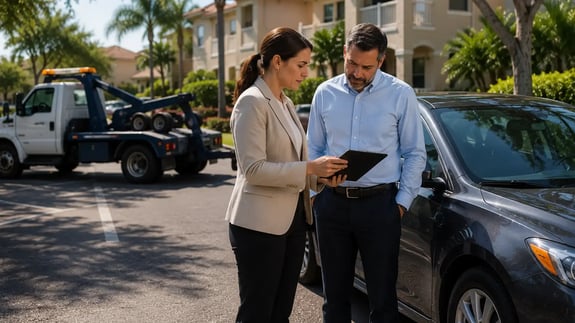
HOA Towing & Booting Webinar
Enforcing parking restrictions through Florida HOA towing is one of the more legally sensitive tools a community association has, and using it correctly means understanding exactly when, where, and how state law allows it. We recently hosted an expert-led discussion with Steven Rappaport of Sachs Sax Caplan Kaskel & Schner, PLLC, who guided board members and property managers through the statutory framework behind removing and immobilizing vehicles.
This informational webinar examined the full lifecycle of vehicle enforcement, from the statutory authority to tow and the signage the law requires, to the practical trade-offs between towing and booting and the newer Florida rules that limit what associations can enforce. The goal was to help communities enforce their parking provisions firmly while staying on the right side of the law and preserving neighborly goodwill.
Disclaimer: This video is for educational purposes only. You will not receive credits for watching the recording. Credits were issued only to those that attended the course.
If you enjoyed this video, check out our YouTube channel and subscribe to view all of our educational videos relating to community association management in Florida.
Key Takeaways
-
Authority Comes from Ownership: An association may only tow or boot from property it actually owns, which means common areas, streets, and guest lots, never a homeowner's private driveway or individually deeded lot.
-
Signage Is Non-Negotiable: Florida law requires proper tow-away or immobilization signs at each entrance and exit, and partnering with a licensed, insured towing company keeps the process compliant and defensible.
-
Booting Adds Visible Deterrence: Immobilization keeps the vehicle in place, tends to cost the offender less, lowers liability risk, and signals to the whole community that parking rules are being enforced.
-
Towing Works Best as a Last Resort: Reserve removal for egregious or repeat violations, and rely on warning letters, fines, and suspensions to resolve the everyday parking issues most communities face.
Where Can an HOA Legally Tow a Vehicle?
The Statutory Right to Tow
Florida Statute 715.07 is the foundation for any association parking enforcement that ends in a tow. The statute gives the owner or lessee of real property, or an authorized representative, the right to remove a vehicle that is parked without permission. For a community association, this means the authority to tow flows directly from ownership of the land where the vehicle sits, not from a sticker, a decal, or a resident's status. Because the right to tow is statutory, it does not have to be written into the governing documents to be valid, though many associations choose to reference it anyway.
Common Property Versus Private Driveways
The ownership principle draws a hard line between common property and a homeowner's own land. In an HOA, the association cannot tow from an owner's private driveway or lot, because the association does not own that ground. It can, however, tow from the streets it owns, from common-area parking, and from clubhouse or guest spaces. Sidewalks and driveway aprons are the gray area, and whether they are fair game depends on whether they fall inside the individual lot line or within the common-area road right-of-way, which often requires checking a survey or the community plat. Most plats show a right-of-way measured from the center line of the road, so a vehicle parked in that strip may be on common property even if it looks like it belongs to the adjacent home.
When a Vehicle Straddles the Line
Vehicles parked half on a driveway and half on the street create real risk. When a substantial portion of the car sits on the owner's property, the safer course is to leave it alone rather than invite a claim of an improper tow. The association still has other enforcement tools in these situations, including violation notices, fines, and suspensions, and towing should be reserved for vehicles resting entirely on common ground such as the roadway, a sidewalk, or a shared grassy swale.
“The basis of this entire seminar is the authority to tow, and it's the owner of the property itself where the vehicle is located. That's the person or entity that has the right to tow the vehicle.” - Steven Rappaport, Sachs Sax Caplan Kaskel & Schner, PLLC
What Makes a Vehicle Subject to Towing
Grounding the Restriction in Your Documents
A vehicle is only unauthorized if it violates a provision the association can actually enforce. That restriction, whether it prohibits street parking, overnight parking, or backing into assigned spaces, has to live somewhere in the governing documents, either as a recorded covenant or as a duly adopted rule. Without a supporting provision, there is nothing to enforce, and the tow has no foundation regardless of what the statute allows.
Declaration Provisions Versus Rules
Where the restriction sits in the document hierarchy matters a great deal. A declaration of covenants or declaration of condominium is the strongest instrument an association has, so its provisions are presumed valid and enforceable and will control over any conflicting rule or bylaw. Rules and regulations, by contrast, are judged against a reasonableness standard and cannot conflict with the declaration. For that reason, restrictions an association truly wants to uphold are often best placed in the declaration itself, which is one reason amending the governing documents comes up so often when boards move to tighten their parking policies.
Signage and Notice Requirements
Meeting the Signage Standard
Florida law sets specific signage requirements that must be satisfied before any vehicle can be towed. Signs must be posted at the property's entry and exit points, typically at the entrance gate and other access points, rather than on each individual driveway. The statute dictates details such as lettering size and placement, and the towing company that an association contracts with will usually supply signage that meets those specifications.
Working With a Licensed Towing Company
The towing relationship should be governed by a written contract that the association's attorney reviews before signing. Boards should confirm the company is properly licensed and insured, and it is worth asking to be named as an additional insured on the towing company's policy. The contract can also spell out logistics such as whether the property will be monitored on a set schedule or checked through random sweeps.
Notice as a Best Practice
Notably, the statute itself does not require personal notice to the vehicle owner, since proper signage at the entrances and exits is technically enough. Even so, sending a friendly warning, a courtesy sticker, or a community-wide reminder before enforcement begins is widely regarded as best practice. Leading with a warning rather than an immediate tow tends to reduce conflict and shows that the community gave residents fair notice.
Towing Versus Booting
The Case for Immobilization
Homeowners' associations have the statutory right to boot as well as tow, and the same ground rules apply. Booting is limited to common property and requires the same style of signage, adjusted to read as an immobilization zone rather than a tow-away zone. A booted car stays visibly in place, which signals to every resident who drives by that the community enforces its rules, whereas a towed car simply disappears. Immobilization also tends to be less expensive for the offender, and because the association never takes possession of the vehicle, it lowers the risk of damage claims and the liabilities that can arise when someone has to retrieve a car from a tow yard.
When Towing Is the Better Option
Towing still has its place. When a vehicle is blocking a driveway, a fire hydrant, or otherwise creating a safety hazard, a boot leaves the obstruction exactly where it is, so removal becomes the only remedy that solves the problem. Many communities are trending toward immobilization as their default, but the right choice depends on the circumstances, and both tools are best weighed with input from the association's management company, insurer, and attorney.
“Towing sends the message to just that one person. But booting sends the message to the entire community that, hey, we're taking this seriously; we enforce our rules. So, you better comply with the rules, or you may end up in the same situation.” - Steven Rappaport, Sachs Sax Caplan Kaskel & Schner, PLLC
Enforcing Restrictions Fairly
Towing as a Last Resort
Even when an association has every right to tow, restraint is usually the wiser approach. Before adopting towing as a remedy at all, board members should ask whether the parking problem is genuinely widespread or merely an occasional nuisance. In many communities, warning letters, violation notices, the fining process, and suspensions of common-area privileges resolve the issue without the friction that towing a neighbor's car inevitably creates.
Case-by-Case Exemptions
Boards can grant reasonable, situational exemptions without triggering selective-enforcement concerns, as long as those exceptions rest on genuine, defensible reasons. Common examples include relaxing street-parking limits for a holiday gathering or large event, giving a temporary pass to a guest who should not drive after a party, or accommodating a resident whose driveway is unusable during approved paver or sealing work. These are courtesies the board may extend at its discretion rather than obligations, and the underlying rules remain fully enforceable.
Resetting After Past Non-Enforcement
Communities that have gone years without enforcing a parking restriction face a familiar dilemma when a new board wants to begin. The concern is selective enforcement, and the remedy is to reset the baseline by republishing the restriction to the entire membership. A community-wide letter that restates the exact provision and gives clear notice that it will be enforced going forward effectively cleans the slate, allowing consistent enforcement from that point on.
“Know your community, and whether or not putting this type of process into place is going to do more harm and cause more grief than it's worth.” - Steven Rappaport, Sachs Sax Caplan Kaskel & Schner, PLLC
How Florida's Newer HOA Parking Law Applies
Protected Vehicles in Driveways
A change to Chapter 720 from the 2024 legislative session added protection for certain vehicles parked in a homeowner's own driveway. Under this HOA-specific law, homeowners' associations generally cannot enforce a documentary restriction against a resident's personal vehicle or work vehicle parked in their driveway, even if that vehicle would otherwise violate the community's rules, such as a prohibition on pickup trucks or commercial lettering. The protection does not extend to genuinely large commercial vehicles, which the state defines by weight, but it does shield the everyday cars and work trucks most residents drive. This rule applies to HOAs and not to condominium associations.
Common Areas Are Still Enforceable
Importantly, this protection changes very little about towing itself, because an association could never tow from a private driveway in the first place. If that same protected vehicle is parked on a common-area street, on the grass, or in a guest space where it is not permitted, the association's ordinary common-area enforcement still applies. Vehicle enforcement is only one corner of a broader wave of recent changes to Florida's community association laws, and boards are wise to review their governing documents and enforcement authority with counsel as those laws continue to evolve.
Parking Enforcement Done Right
Towing and booting are powerful tools, but their real value lies in how carefully they are used. An association that grounds every action in clear document provisions, posts the required signage, confines enforcement to property it actually owns, and treats removal as a measured last resort will protect both its authority and its relationships with residents. Approached this way, parking enforcement becomes less about penalizing neighbors and more about maintaining the safe, orderly, and fair community that residents are glad to call home.
Frequently Asked Questions
Can an association tow vehicles parked on public roads within the community?
Generally no, because the authority to tow flows from owning the underlying property, so a car on a public road should not be towed even if a community rule addresses it. Fines may still be an option, but removal from a public road invites unnecessary liability.
Can a condominium tow from a resident's assigned parking space?
Often yes, because assigned spaces in a condominium are usually limited common elements owned collectively by all unit owners rather than by the individual, which places them on common property. That differs from an HOA, where a vehicle on an owner's deeded driveway cannot be towed.
If a community already tows, can it start booting right away?
Not without redoing the groundwork, since the association needs updated immobilization signage, a new contract with a licensed and insured booting company, and attorney review, just as it would for towing. Only after those pieces are in place should immobilization begin.
Check out our blog for expert insights, timely industry updates, helpful resources, and recaps of our educational webinars.
Ashley Dietz is the VP of Marketing at Campbell Property Management and has led the company’s educational and marketing initiatives since 2013. A Florida Atlantic University graduate with a bachelor’s degree in communications, Ashley specializes in community association education, digital outreach, and industry engagement for Florida HOAs and condominiums.