Condo Official Records Retention Requirements Webinar
Few compliance duties have shifted as quickly for boards as Florida condo records retention, where a single amended statute can change what a community must keep, post, and hand over on request. We recently hosted an expert-led discussion with Michael Ungerbuehler from Sachs Sax Caplan Kaskel & Schner, PLLC, to help condo board members and managers make sense of the current rules.
This knowledge-sharing webinar traced the definition of an official record, the retention clock attached to each type, and the documents that now have to live on an association's website. It also worked through the inspection process, the exemptions that keep sensitive information private, and the escalating penalties that follow a request handled poorly.
Disclaimer: This video is for educational purposes only. You will not receive credits for watching the recording. Credits were issued only to those that attended the course.
If you enjoyed this video, check out our YouTube channel and subscribe to view all of our educational videos relating to community association management in Florida.
Key Takeaways
- What Qualifies as an Official Record: Any association-related document in the association’s possession is considered an official record, regardless of whether it is kept in paper or electronic.
-
Permanent Versus Seven Years: Governing documents, developer materials, rules, and minutes are kept forever, while most other records must survive at least seven years.
-
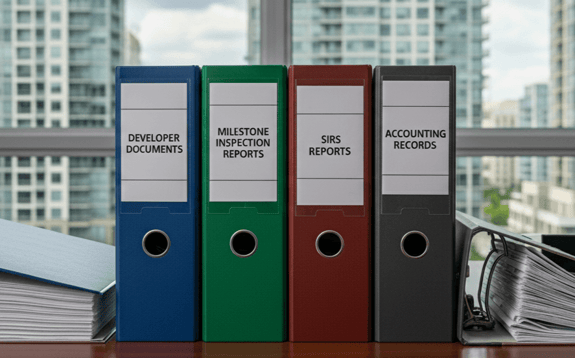
Milestone and SIRS Reports: Buildings of three or more habitable stories must retain their structural inspection and reserve study reports for fifteen years.
-
Access Is Not Optional: Owners get access within ten business days, and intentional denial can lead to fines, fees, and even criminal exposure.
What Is Considered an Official Record?
An official record is any written document that concerns the association, whether a condominium or HOA, and is in the association’s possession. That definition is intentionally broad, covering everything from governing documents and meeting minutes to a single reimbursement receipt submitted by a maintenance worker.
The Records Qualification Test
The test does not care whether a document is printed or electronic, since the state treats a file on a laptop or website the same as a piece of paper. Governing documents, board and member meeting notices, the membership roster, insurance policies, contracts, election materials, and the full range of financial records all qualify. Section 718.111(12) of the Florida Statutes lists these categories and then closes with a catch-all, which is why owners are entitled to review invoices, bids, bank statements, and a current account statement for every member.
What the 2025 Updates Added
House Bill 913 expanded the list again as of July 2025, and several additions are easy to overlook. Committee meeting minutes are now official records, because committee meetings are treated like board meetings unless the bylaws specifically exempt them. Recordings of video conference meetings, bank statements and ledgers, and the growing set of required affidavits were all folded in as well, each carrying its own maintenance duty.
“If it's in writing, if it's about the association, and in the association's possession, then it's an official record.” - Michael Ungerbuehler, Sachs Sax Caplan Kaskel & Schner, PLLC
Retention Periods for Condo Records
Florida sets a layered retention schedule rather than a single deadline, so the honest answer to how long condo associations keep records depends entirely on the record. Most documents carry a seven-year floor, a handful must be kept permanently, and two categories sit on timelines of their own.
Permanent and Seven-Year Records
Anything provided by the developer, the governing documents and all their amendments, every version of the rules, and all meeting minutes must be kept for the life of the association and never discarded. Everything else that meets the definition of an official record carries a minimum seven-year retention period. Records lost before these rules took effect cannot be recreated, though a board still has a duty to try to recover them, a point covered further below.
Election Materials and Structural Reports
Election materials are the shortest category and only have to be kept for one year, even though the window to challenge an election closes after sixty days. Associations with staggered terms that fill midterm vacancies by owner vote are wise to hold these longer to avoid untangling questions later. The requirement reaches well beyond high-rise condominium communities, applying to any building of three or more habitable stories, where milestone inspection reports and structural integrity reserve study reports must be retained for fifteen years and updated every decade.
“At this point going forward, you have to keep all of your documents for at least seven years. There are some things that have to be kept permanently, so keep that in mind.” - Michael Ungerbuehler, Sachs Sax Caplan Kaskel & Schner, PLLC
Records That Belong Online
Condominiums with twenty-five or more units must maintain a website or app and post a defined set of official records there. The threshold dropped sharply from one hundred fifty units, pulling many smaller condominium communities into a requirement they may not realize applies to them.
The Twenty-Five-Unit Website Rule
The required documents include the governing documents, the current rules, the proposed and adopted annual budgets, the most recent financial report, and director certificates showing each board member completed certification and the annual legal update. Meeting notices and agendas for board, member, and committee meetings belong there as well, along with conflict-of-interest contracts. Buildings subject to structural requirements must also post their milestone inspection and reserve study reports and any permits for ongoing work.
Posting Deadlines and Contracts
The outside deadline to post a record is thirty days from when it is created or received, but statutory notice rules often shorten that. Board meeting notices must appear at least forty-eight hours ahead, and member meeting notices at least fourteen days ahead. A newer wrinkle requires the full contract to accompany any meeting notice where the board will approve it, which means nearly every contract eventually lands on the website.
Handling a Records Inspection
A member is entitled to access official records within ten business days of a written request, and the association is not required to mail or email anything that is not already posted online. Access means the member reviews the records where they are kept, not a concierge delivery to wherever the member happens to be.
The Ten-Day Response and Checklist
Along with access, the association must provide a checklist that identifies every category requested, what was made available, and what was withheld along with the reason. A record that is exempt, or one genuinely lost despite a good-faith effort to recover it, is noted on that list rather than quietly ignored. Keeping records organized also matters here, since document dumps are no longer permitted for condos and can draw a fine on their own, unlike the lighter standard that governs homeowners' association records.
“You have to provide a checklist that says, here's all the categories of stuff you wanted, here's what's been made available, here's what wasn't made available to you, and why.” - Michael Ungerbuehler, Sachs Sax Caplan Kaskel & Schner, PLLC
Penalties for Getting It Wrong
Late access can trigger damages of fifty dollars per day up to five hundred dollars, plus the requesting member's attorney fees and a state fine assessed per unit. An arbitrator can order the records produced at no charge and require the association to post notice of the violation. The stakes climbed further when the Legislature made a knowing or willful refusal to provide timely access a crime, a shift that sharpens the consequences of failing to maintain official records.
Records Owners Cannot Inspect
Not every document an association holds is open to inspection, and a short list of categories stays protected. These exemptions exist to shield privileged advice, active litigation strategy, and sensitive personal details from disclosure.
Legally Protected Documents
Attorney-client communications among the association's counsel, its board, and its management are always exempt, and that protection is easily waived the moment anyone outside that circle is brought in. Work-product materials prepared in anticipation of litigation stay exempt while the matter is active and for a period afterward, then become inspectable. Information gathered to review and approve unit sales or leases is permanently off-limits as well.
Private and Confidential Information
Medical records of residents and the disciplinary or health portions of personnel files remain confidential, though salary figures reflected in financial records are still fair game. Identity information such as Social Security numbers, driver's license numbers, and credit card numbers is exempt, as are personal contact details not provided for notice purposes. Website passwords and similar access credentials round out the list of what an owner cannot demand to see.
Building a Reliable Records System
Records management now sits among the clearest signals of a well-run condominium, right alongside sound budgeting and timely maintenance. Boards that can define an official record, match each document to its correct retention timeline, keep the required files posted, and answer inspection requests on time remove one of the most common openings for owner disputes and state fines. Treating condo board records compliance as an everyday habit, rather than a scramble after a request arrives, protects the association's owners and its reputation for years to come.
Frequently Asked Questions
Are board members' personal emails considered official records?
Only when the association is involved. Emails sent among board members on personal accounts, with no management copied and nothing on an association-owned domain, are generally not official records, but the moment management is included or an association email address is used, the message becomes inspectable.
How long do we keep a recording made only to help prepare the minutes?
Only until the minutes are adopted. A recording created solely for note-taking can be discarded once the minutes are approved, which is different from a required video conference recording that must be kept for at least a year.
Does an owner's email address become inspectable if they opt into email notices?
Yes. When an owner provides an email address to receive official notices electronically, that address becomes an official record other owners can inspect, so consenting to email delivery also means consenting to that disclosure.
Visit Florida Association News (FAN) for timely legal updates, helpful resources, and practical guidance for community associations.
Ashley Dietz is the VP of Marketing at Campbell Property Management and has led the company’s educational and marketing initiatives since 2013. A Florida Atlantic University graduate with a bachelor’s degree in communications, Ashley specializes in community association education, digital outreach, and industry engagement for Florida HOAs and condominiums.