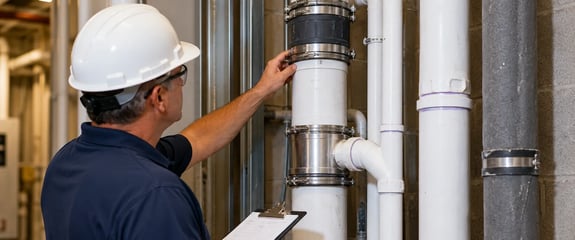
In a Florida condominium, plumbing liability often turns on where the problem originated and who was responsible for maintaining that component. Associations generally maintain common-element plumbing, while owners are responsible for fixtures and plumbing serving only their unit.
Key Takeaways:
- Repeated backups and prior notice may strengthen a claim, but they do not automatically prove the association caused the problem.
- Maintenance records and prior work orders can become important evidence when the source of a plumbing failure is disputed.
- A plumbing incident inside a unit may be treated differently from a similar condition in a common area.
- Recurring common-element plumbing problems should be treated as potential liability issues, not just routine maintenance concerns.
When Can Faulty Plumbing Create Liability for a Condo Association?
Florida law provides that condominium associations are responsible for damage caused by backups due to faulty plumbing common elements, which associations are required to maintain and repair. As a recent appellate ruling illustrates, Florida condo plumbing liability can potentially go beyond property damage to include personal injury claims.
The decision by the Third District Court of Appeal arose from a case that originated in Miami-Dade Circuit Court involving the Parkwood Condominium located in the Fontainebleau neighborhood near Doral. In 2021, unit owner Cecilia Vera was injured when she slipped and fell in her bathroom due to water and sewage on the floor, and she subsequently filed a premises liability lawsuit against the association alleging negligence.
How Is Responsibility Determined When the Source of a Plumbing Backup Is Disputed?
The complaint alleges the flooding was a recurring issue that the association was on notice of, and it had hired a contractor in 2020 to remediate the repeated backups that caused it in her bathroom. Vera, her adult children, and the association’s representative testified during the course of the litigation, but none of them could identify the source of the blockage that caused the backup.
However, Vera argued there was evidence establishing that it was caused by a problem in the condominium’s pipes rather than with the toilet or wastewater pipes that were part of her unit and thus her responsibility to maintain. She cited her deposition testimony as well as that of her children regarding prior incidents of backups, which they reported to the association, and a 2020 work order for a clog in the building’s sanitary stack pipes associated with her unit.
Vera also testified that she replaced her toilets but the backups kept occurring, and she cited testimony from the association’s representative that a backup in the condominium’s sanitary stack pipes could cause the toilets and shower to overflow in the unit.
The association moved for summary judgement on the basis that Vera could not establish that the backup was caused by its failure to maintain the premises in a reasonably safe condition. After a hearing, the circuit court granted summary judgement in its favor.
In the subsequent appeal, Vera contended that she provided enough evidence that the water she slipped on was a regularly occurring condition and the association had been notified of prior incidents. She argued that in accordance with the state’s transient substance case law, she was not required to prove how or when the water came to be on her bathroom floor, nor that the association caused the condition that led to it.
The appellate court unanimously concluded that this argument would carry the day if Vera’s slip and fall had occurred in a common area of the property. However, she could not rely on such case law because it had instead taken place inside of her unit.
The prior rulings did not apply because while the association was responsible for maintaining the building’s sanitary stack pipes serving all the units, Vera was responsible for maintaining the plumbing inside of her dwelling that connected to the common-element pipes.
For a broader discussion of condominium maintenance responsibilities and the importance of preventive maintenance, feel free to watch this preventive maintenance CEU course.
Because the water intrusion could have been from a problem either in the pipes in her unit that were her responsibility or in the condominium’s stack pipes, it was incumbent on her to provide evidence to support a reasonable inference that it was more likely than not that the spillage was caused by the association’s negligence in maintaining the common-element pipes. Rather than providing such evidence, the depositions of every witness included testimony that they did not know the source of the blockage that caused the backup.
Given the lack of evidence supporting that the spillage was due to a problem in the condominium’s sanitary stack pipes rather than Vera’s wastewater pipes, the Third DCA affirmed the lower court’s summary judgement.
Who Is Responsible for Plumbing Repairs in a Florida Condo?
Association Responsibility for Common-Element Plumbing
In accordance with Florida law, condo association plumbing responsibility generally applies when a burst pipe or plumbing failure serves more than one unit, lies within a shared wall, or is designated as common property in their governing documents.
Unit Owner Responsibility for In-Unit Plumbing
Individual unit owners are responsible for plumbing fixtures or appliances that serve only their specific unit (e.g., washing machine hoses, individual water heaters, and toilets).
What Happens When an Association Ignores a Known Plumbing Issue?
If an association fails to act on a known or foreseeable common-element plumbing issue, such as those stemming from aging riser pipes, it may be held liable for any resulting property damage or personal injuries. Condominium association insurance policies will then typically cover damage to a building’s structural components, drywall, and “as originally installed” property.
As this ruling illustrates, associations that are negligent in maintaining shared plumbing elements or ignore documented reports of corroded pipes can be held liable for resulting property damage and injuries. Owners will generally be liable for damage and injuries caused by overflowing toilets, burst hoses, or neglected water heaters in their individual unit. The exact division of responsibility and repair costs will be dictated by supporting evidence of the source of the plumbing failure as well as the association’s governing documents.
Learn more with Campbell
Campbell Property Management regularly hosts educational webinars related to condominium maintenance responsibilities, legal updates, reserves, property operations, and other issues affecting Florida condominium and HOA communities. Visit CampbellEvents.org to explore upcoming webinars and educational opportunities for board members, property managers, and community association professionals.
This article was originally published in the Siegfried Rivera blog. Click here to read it on the firm's website.
Michael L. Hyman with the South Florida law firm of Siegfried Rivera has focused on community association law since 1970 and is based at the firm’s Coral Gables office. He is the author of the two-volume “Florida Condominium Law and Practice” and is board certified as an expert in community association law by The Florida Bar. Michael is a regular contributor to the firm’s Newsroom blog at www.SiegfriedRivera.com/blog. The firm also maintains offices in Broward and Palm Beach counties, and its 49 attorneys focus on real estate, community association, construction and insurance law.