

HOA Meetings, Elections, and Governance Guide
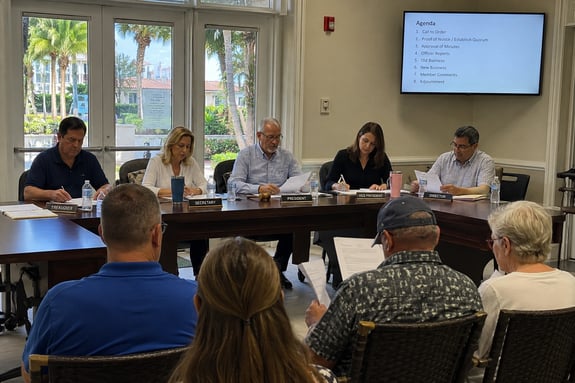
Running compliant HOA meetings depends on understanding the rules that control notice, quorum, owner participation, and the elections that keep a board properly seated. We recently hosted a CEU course featuring Evonne Andris from Siegfried Rivera, who guided Florida board members and property managers through the procedural foundations of homeowners association governance.
This resourceful webinar examined how meetings, elections, and governance connect under Chapter 720, covering board and membership notice timelines, candidate eligibility, proxies, and the requirements for moving an association to online voting. Attendees came away with a clearer sense of how disciplined procedure protects an association and keeps its decisions defensible.
Disclaimer: This video is for educational purposes only. You will not receive credits for watching the recording. Credits were issued only to those that attended the course.
If you enjoyed this video, check out our YouTube channel and subscribe to view all of our educational videos relating to community association management in Florida.
Key Takeaways
-
Bylaws Control the Process: An association's bylaws are the primary source for how meetings are called and how elections run, so boards should confirm their own notice, quorum, and voting provisions before acting.
-
Notice Timelines Differ by Meeting: Board meetings require notice posted at least 48 hours in advance, while membership meetings generally need 14 days of mailed notice when the governing documents are silent.
-
Eligibility Carries Hard Limits: Owners who are delinquent on association obligations or carry certain felony convictions cannot appear on the ballot, and a director who falls more than 90 days behind forfeits the seat.
-
Online Voting Requires Authorization: Electronic voting requires a board resolution adopted at a properly noticed meeting, must keep ballots secret and recountable, and cannot remove the option to vote by paper ballot.
What Types of Meetings Does an HOA Hold?
Board and Membership Meetings
Board meetings handle the routine decisions of the community, from approving contracts to setting policy. Membership meetings are less frequent and usually tied to a specific action by the owners, most often an amendment to the governing documents, which commonly requires a vote of two-thirds of the voting interests unless the documents set a different threshold. Boards should always check their own documents for the controlling number, and many of the habits that make for an effective board meeting apply no matter which type of meeting is on the calendar.
Other Meeting Types
Beyond these, an association will encounter budget meetings, non-emergency and emergency special assessment meetings, and meetings to adopt rules for parcel or common-area use. Closed board meetings are a separate category, limited to the board and its legal counsel, and reserved only for personnel matters or pending and potential litigation.
Notice, Agendas, and Owner Participation
Notice Requirements
Notice of a board meeting must be posted conspicuously at a designated location at least 48 hours in advance, unless the governing documents require more time or a state of emergency has been declared for the county. Membership meetings follow the timeline in the governing documents, but when those are silent, a 14-day mailed notice to all owners is required. Compliance is proven through an affidavit signed by the person who posted or mailed the notice and kept among the official records.
Associations that use electronic notice may send it only to owners who registered an email address for that purpose, and those addresses then become official records. Electronic notice is not the same as online voting, and it must include a hyperlink to the website where the notice is posted. An association may also broadcast the notice and agenda on a closed-circuit cable system, as long as the material stays on screen long enough to be read and understood.
Agendas and Participation
A board meeting agenda must list every item to be addressed, and vague entries such as a bare “old business” or “new business” line are not adequate. The better practice is to state exactly what will be discussed, for example, the discussion and approval of a named pool service contract, which keeps the meeting focused and prevents owners from raising matters the board did not intend to take up. A special meeting carries the added requirement that its notice describe the meeting's purpose.
Board and membership meetings are open to parcel owners, who have the right to speak for at least three minutes on any agenda item and to record the proceedings under the association's reasonable rules. The strongest practice is to take a motion and a second, allow board discussion, then invite owner comment before the vote, which keeps the conversation tied to the matter at hand and mirrors the discipline of running efficient and harmonious board meetings. Open good and welfare discussion is better placed after adjournment, and owners may photograph documents shown at a meeting, such as a working budget, which the association cannot prohibit.
"You want your agenda to be as specific as possible. Leaving an agenda broad opens the door to questions and concerns from the floor. The more detailed your agenda is, the better it is for you." - Evonne Andris, Siegfried Rivera
Quorum, Proxies, and Voting
Quorum and Proxies
For a membership meeting to proceed, a quorum must be present, typically 30 percent of the voting interests unless the bylaws set a lower number. Owners may participate in person or by proxy, and proxies count toward both the quorum and the vote. An owner may collect and deliver a stack of proxies for others, though the collector cannot cast those votes, since each owner directs their own proxy, and the governing documents sometimes cap how many proxies one person may carry.
Two proxy forms are common: a general proxy that lets the holder vote on any matter, and a limited or directed proxy that records how the owner wants each item voted. A limited or directed proxy is generally preferable because it keeps the owner's intent clear and reduces the disputes that broad authority can invite.
Electronic Voting
Moving to online voting begins with a board resolution that authorizes the system, notifies members of the opportunity to vote electronically, and sets reasonable procedures and deadlines for owners to consent or opt out. The meeting where that resolution is considered requires the same 14-day notice and affidavit of compliance as other membership business. The system must authenticate each voter, confirm it is working at least 14 days before the vote, issue a receipt, preserve ballot secrecy, and store ballots so they remain available for any recount or review.
Electronic votes count toward quorum, but an association cannot go fully paperless, since owners who prefer a traditional ballot must still be able to use one, and once an owner opts in, that choice carries to later elections unless they opt out. Informal polls and surveys are different, carrying no official weight and requiring no authorization, because they only gauge sentiment. Online voting must also be adopted association by association, so a sub-association's decision does not bind its master association, or the reverse.
Elections, Eligibility, and Vacancies
How HOA Elections Work
Most associations hold an annual meeting once a year for general business, and the election of directors, when required, takes place at that same meeting. The annual meeting notice need not describe its purpose, but it must state that it is the annual meeting and that an election will be held if the governing documents call for one. An HOA does not follow the statutory election process that applies to condominiums unless its bylaws specifically adopt the procedures in Chapter 718, the Florida Condominium Act, so the governing documents control how nominations and voting proceed.
Nominations may be made in advance or from the floor, and members may nominate themselves at the meeting. When the number of candidates does not exceed the open seats and write-in nominations are not used, no election is necessary, and those candidates take their seats regardless of whether a quorum is reached. Special meetings of the membership can also be called by the board or by a petition representing at least 10 percent of the voting interests.
Eligibility and Vacancies
Florida law sets minimum eligibility standards. An owner who is delinquent on any fee, fine, or other monetary obligation on the day they could last be nominated cannot appear on the ballot, and a sitting director who becomes more than 90 days delinquent is deemed to have abandoned the seat. A person convicted of a felony is ineligible unless their civil rights have been restored for at least five years before the election, and governing documents may impose stricter requirements, in which case the stricter standard applies. When nominations are taken from the floor, preparing a current delinquency ledger in advance is the practical way to confirm eligibility on the spot.
Unless the bylaws provide otherwise, a vacancy that occurs mid-term may be filled by a majority vote of the remaining directors, even if they are fewer than a quorum, or by the sole remaining director, with the appointee serving the unexpired term; a vacancy created by a recall instead follows Chapter 720.303 and the division's recall rules. When no one runs or a quorum is not reached, the current directors hold over until a successor is seated. Boards that lean on professional support for meetings, planning, and decision-making are often better positioned to keep seats filled and avoid a court-appointed receiver, a costly last resort that arises when a community cannot maintain itself or attract any volunteers to serve.
Board Communication, Fraud, and Disputes
Email and Board Decisions
Directors may use email to share information and discuss association matters, but they cannot cast a binding vote by email, and substantive decisions, including the selection of vendors and contractors, belong in an open board meeting. Ratifying an action and confirming it at the next meeting should be reserved for the rare case where work genuinely cannot wait. Whether routine emails between directors count as records depends on the circumstances, since messages among board members alone are generally not official records, though copying the property manager or an association business account can change that, a nuance covered more fully in an association's recordkeeping requirements.
“Members of a board of directors are allowed to use email as a means of communication. However, a board member may not cast a vote upon association-related matters via email.” -Evonne Andris, Siegfried Rivera
Voting Fraud and Disputes
Florida treats several election-related acts as first-degree misdemeanors, including falsely swearing an oath connected to a vote, taking part in any ballot fraud, preventing an owner from voting or altering how their vote is recorded, and using threats, bribery, or intimidation to influence a voter. Offering something of value to buy a vote is also prohibited, though nominal campaign items such as a banner, a pen, or a campaign t-shirt, along with food served at the meeting, do not fall under the rule, and knowingly helping or concealing another person's fraudulent voting is itself a misdemeanor.
When an election dispute arises between a member and the association, it must go to binding arbitration with the state's Division or be filed in a court of competent jurisdiction. Arbitration follows the procedures in the Condominium Act at Chapter 718.1255 and the division's rules, and because an association is a corporation, it must be represented by counsel in those proceedings.
Frequently Asked Questions
Are emails between board members official records?
Messages exchanged only among directors are generally not considered official records of the association. That can change, however, if the property manager or an official association email account is copied on the conversation.
Do online polls and surveys count as votes?
No. Polls and surveys only measure member sentiment and hold no official weight, so they do not require the authorization or procedures that a formal electronic vote does.
Can the board change officer positions during the year?
Yes. Officers can be reassigned at a board meeting held with 48 hours' notice, as long as the bylaws do not impose a specific restriction.
Browse our blog for practical association management tips, industry news, educational content, and past webinar events.
Ashley Dietz is the VP of Marketing at Campbell Property Management and has led the company’s educational and marketing initiatives since 2013. A Florida Atlantic University graduate with a bachelor’s degree in communications, Ashley specializes in community association education, digital outreach, and industry engagement for Florida HOAs and condominiums.