Fiber Optic Technology Fundamentals Webinar
In today's digital age, reliable and high-speed internet is no longer a luxury but a necessity for modern communities. In our recent continuing education course, industry expert Jose Eguez from Fibernow shared essential insights into the fundamentals of fiber optic technology, explaining its superiority over traditional broadband and the significant benefits it brings to communities.
The course provided essential fiber optic knowledge, covering the history, construction, and transmission process of fiber optics. It highlighted the long-term advantages of fiber, such as unparalleled speed, durability, and its ability to future-proof communities against growing bandwidth needs. Participants gained a clear understanding of why condo and HOA fiber internet upgrades are becoming increasingly vital for resident satisfaction and property values.
Disclaimer: This video is for educational purposes only. You will not receive credits for watching the recording. Credits were issued only to those that attended the course.
If you enjoyed this video, check out our YouTube channel and subscribe to view all of our educational videos relating to community association management in Florida.
Key Takeaways
-
Fiber Optic Fundamentals: Fiber optics transmits information using light through glass, offering superior speed and reliability compared to traditional copper-based systems.
- Future-Proofing Communities: Fiber infrastructure is durable and designed for longevity, with upgrades primarily involving electronics rather than the physical cables, ensuring communities are prepared for future bandwidth demands.
- Enhanced Property Value: Communities with fiber-to-the-home (FTTH) infrastructure can see a 3-5% increase in property resale value.
-
Reliability and Speed: Fiber is impervious to environmental factors like lightning and flooding, providing consistent, high-speed internet without degradation, even with multiple connected devices.
What is Fiber Optics and How Does it Work?
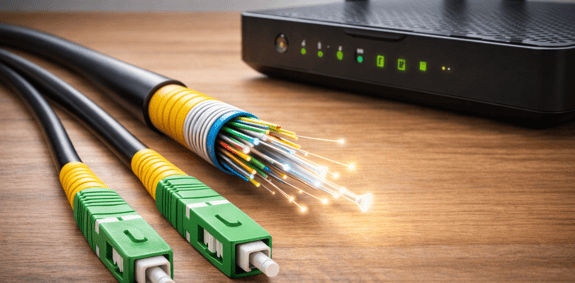
Fiber optics is a revolutionary medium for transporting information, utilizing light signals through thin strands of glass. Unlike traditional copper-based systems like coaxial wires or twisted pair, fiber optics leverages the principle of total internal reflection to transmit data at incredible speeds over long distances. This fundamental difference is why fiber-optic technology fundamentals are crucial for understanding modern internet infrastructure.
While fiber optics might seem like a recent innovation, its underlying principle dates back to the 19th century. Early experiments, such as the "Water Fountain Spark," demonstrated how light could be guided through a medium, laying the groundwork for what would become fiber optic communication. The real breakthrough came in 1970 when Corning developed glass pure enough for light to travel long distances without significant loss, paving the way for its widespread adoption.
"Fiber optics has been around for quite some time... it started, actually, back in the 19th century with an experiment called the Water Fountain Spark, where someone took light and put it through a water fountain, and the light kind of seemed like it was bending." - Jose Eguez, Fibernow
Fiber-to-the-Home (FTTH) vs. Traditional Broadband
One of the key distinctions in broadband architecture is between fiber-to-the-home (FTTH) and older methods. FTTH brings the fiber connection directly to individual living units, offering a significant upgrade in performance. This contrasts sharply with traditional systems that often rely on copper for the final stretch to the home, which can degrade signal quality and speed. The demand for high-speed internet grew exponentially in the early 2000s with the rise of personal computers and the internet, driving the implementation of fiber optics over thick copper cables.
Advantages of Fiber Over Copper and Coaxial Technologies
The superiority of fiber optics over copper and coaxial cables is multifaceted, primarily stemming from its physical construction and the way it transmits data. Fiber, being made of glass, is impervious to environmental factors that plague copper-based systems.
This inherent durability means fiber optic cables do not rust, are unaffected by lightning, and perform consistently even in adverse weather conditions, ensuring a more reliable internet service for residents. This makes fiber optics for condos and HOAs a particularly practical option in areas prone to severe weather.
"This medium is made out of glass... and the other mediums, like twisted pair, coaxial, ethernet, they're all made out of copper. And copper is acceptable to the environment... So it rusts over time. You know, if there is a thunderstorm, lightning affects it. If there's flooding, it's affected. So all of that has an impact in the reliability of the service that you receive at your home." - Jose Eguez, Fibernow
Future-Proofing Your Community
One of the most compelling advantages of fiber optic infrastructure is its ability to future-proof a community. Once installed, fiber optic cables are designed to last for hundreds of years without degrading. Upgrades to speed and capacity primarily involve changing the electronic equipment at either end of the fiber, not replacing the physical cables themselves. This means that as technology advances and bandwidth demands increase, communities with fiber infrastructure can easily adapt without costly and disruptive overhauls.
Increased Property Value and Resident Satisfaction
Investing in HOA fiber internet upgrades can increase the resale value of homes within a community. On average, properties in communities with fiber-to-the-home infrastructure see a 3-5% increase in their resale value. Beyond monetary benefits, residents experience unparalleled speed and reliability, leading to higher satisfaction. This is particularly important as internet access has transitioned from a commodity to a necessity, with households relying on multiple devices for work, education, and entertainment.
Understanding Fiber Upgrades for Community Associations
For community associations considering HOA fiber internet upgrades, understanding the benefits and implementation process is key. Engaging with providers who specialize in community solutions can help navigate the complexities of installation and ensure a smooth transition. These upgrades not only enhance the daily lives of residents but also position the community for long-term technological relevance.
Frequently Asked Questions
How does fiber optics compare to traditional copper-based internet?
Fiber optics transmits data using light through glass fibers, making it significantly faster and more reliable than traditional copper or coaxial cables, which use electrical signals. Copper is susceptible to environmental degradation (rust, lightning, flooding), leading to inconsistent service. Fiber, being glass, is immune to these issues, providing stable and high-speed connections.
What should HOA boards consider before upgrading internet infrastructure?
Fiber infrastructure is designed to support growing technology demands for decades without requiring major cable replacement. As internet usage continues to increase through remote work, smart devices, streaming services, and cloud-based systems, fiber provides communities with scalable bandwidth and reliable connectivity that can adapt to future needs.
Visit our events page to register for upcoming educational webinars and courses designed to help you stay informed and compliant.
Ashley Dietz is the VP of Marketing at Campbell Property Management and has led the company’s educational and marketing initiatives since 2013. A Florida Atlantic University graduate with a bachelor’s degree in communications, Ashley specializes in community association education, digital outreach, and industry engagement for Florida HOAs and condominiums.