After a storm, Florida associations often face disputes over insurance claims, repair responsibility, emergency powers, vendor contracts, records, and communication. Many of these problems are not created by the storm itself. They usually trace back to decisions, documentation, and planning that did or did not happen during the quiet months before hurricane season peaks.
Key Takeaways:
- A quiet forecast can cause boards to delay the work that prevents post-storm disputes.
- The best defense against storm-related claims disputes is clear documentation before damage occurs.
- Boards should understand insurance boundaries, emergency authority, and vendor options before recovery begins.
- Records and communication problems can turn a difficult storm recovery into a legal conflict.
Forecasters expect a below normal hurricane season this year. NOAA puts the odds of below normal activity at 55 percent, projecting 8 to 14 named storms with 3 to 6 becoming hurricanes. Last season, for the first time in a decade, no hurricane made landfall on the continental United States.
Most preparedness advice is written before a storm. I want to describe what I see afterward, because Florida HOA and condo hurricane disputes that follow a hurricane are remarkably consistent, and almost all of them trace back to decisions made in the quiet months.
What Disputes Do Associations Face After a Hurricane?
Claims denied over the condition of the property beforehand.
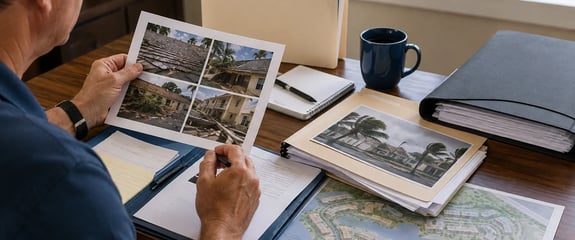
This is the most common and the most preventable. A carrier disputes whether damage came from the storm or from deferred maintenance that predated it. Without dated photographs, inspection reports, and maintenance records establishing the condition of roofs, walkways, and common elements before the storm, the association is arguing from memory against an adjuster arguing from a report. That is a difficult position, and it is entirely avoidable with an afternoon of documentation in August.
Campbell’s webinar on hurricane claims also discusses hurricane insurance policies, preparedness, recovery, and dispute resolution.
Disagreements over who pays for what.
After a storm, the boundary between unit and common element becomes the center of the argument. Owners assume the association covers more than it does. Boards sometimes assume the opposite. The answer lives in the declaration and in the applicable statute, and reading it for the first time while owners are displaced is not a good process. Boards that have reviewed and communicated those boundaries in advance spend the recovery on recovery.
Emergency powers used incorrectly, or not used at all.
Florida law grants association emergency powers before and after a declared emergency, including the ability to act without ordinary notice and meeting requirements in defined circumstances. Those powers are real and they are also bounded. Boards that exceed them create exposure. Boards that fail to use them stall on decisions that needed to happen the same week. Either failure produces litigation.
Contracts signed under pressure.
Restoration and debris removal agreements executed in the days after a storm are often the worst contracts an association will ever sign. Terms are unfavorable, scope is vague, and pricing is set by scarcity. Associations that identify and contract with vendors before the season have leverage. Associations calling for the first time during a warning do not.
Records and communication failures.
Disputes escalate when owners cannot get information. Florida's records access and website requirements exist year round, but they become acute when owners are out of state and trying to understand what their board is doing. An association that cannot produce records promptly during a recovery invites the exact conflict it is trying to avoid.
What this means for a quiet season
The forecast describes the basin. It does not describe your community, and an association's legal obligations do not adjust downward when the outlook improves. The duty to maintain common elements, to carry required coverage, to keep records accessible, and to act reasonably in protecting property is identical in a slow year.
What changes in a quiet season is attention. Two consecutive years without a significant Florida landfall makes boards feel they have time, and time is precisely what disappears once a storm is named.
The peak of the season is September 10, and elevated activity typically continues through October. Between now and then, the work that prevents litigation is unglamorous: confirm coverage and understand what it actually covers after two years of shifting policy terms, photograph and document current conditions, review emergency powers with counsel, secure vendor relationships, and verify owner contact information including seasonal residents.
Associations that come through a difficult storm in reasonable shape are almost never the lucky ones. They are the ones that did this work in August.
Learn more with Campbell
Campbell Property Management regularly hosts webinars related to hurricane preparedness, legal updates, insurance, maintenance, and community association education for Florida board members and property managers. Visit CampbellEvents.org to explore upcoming webinars and educational opportunities for board members, property managers, and community association professionals.
Larry Schner joined Sachs Sax Caplan Kaskel & Schner, PLLC on December 1, 2016 after maintaining his own practice of Larry E. Schner, P.A. for twenty-five years in Boca Raton. Mr. Schner practices in the area of Community Associations Law, representing condominium and homeowners throughout Broward and Palm Beach County. He has extensive experience in this area and has represented hundreds of associations since his admission into the Florida Bar in 1985.