Sports Courts Cost & Construction Webinar
Few amenities generate as much resident enthusiasm, or as much budget anxiety, as a new court, which is why sound sports court construction planning pays off long before the first load of base rock arrives on site. We recently hosted an online seminar featuring Pedro Obregon of Armor Courts, who showed board members and property managers how these sports courts are actually built and what they should cost.
This expert-led educational webinar traced the full arc of a court project, from the hidden layers beneath the playing surface to grading, curing, and contractor selection, with real budget ranges for tennis, pickleball, and padel. Attendees came away better prepared to plan for a full life cycle and steer clear of the expensive mistakes that only surface years after a court is poured.
Disclaimer: This video is for educational purposes only. You will not receive credits for watching the recording. Credits were issued only to those that attended the course.
If you enjoyed this video, check out our YouTube channel and subscribe to view all of our educational videos relating to community association management in Florida.
Key Takeaways
-
The Base Is the Real Asset: The acrylic surface everyone admires matters least; a court's lifespan rests on the compacted subgrade, base rock, and pavement hidden beneath it.
-
Water Decides Everything: Courts fail from poor drainage far more often than from heavy use, so correct slope and grading protect the investment for decades.
-
Conversion Beats New Construction: Restriping an underused tennis court into four pickleball courts costs a small fraction of building dedicated courts from scratch.
-
Budget for the Life Cycle: Every surface needs periodic resurfacing, so weigh twenty-year costs rather than deciding on the day-one price alone.
What Lies Beneath a Court?
Whether a board is weighing its first court or replacing a worn one, the same construction fundamentals decide how long that investment lasts for a condominium community or HOA. The finished playing surface gets all the attention, but it is the least important structural part of the whole assembly.
The Layers You Never See
A court is built from the ground up in distinct layers. It starts with the native subgrade, the soil itself, which has to be stable and properly compacted before anything goes on top of it. Next comes roughly four to six inches of crushed concrete, crushed stone, or limestone base that sets the elevation and creates a stable platform. Only then is the structural pavement laid, either asphalt or concrete, followed by the acrylic coating system and finally the striping, nets, posts, fencing, and lighting. A fresh coat of paint can make even a poorly built court look flawless on opening day, but if the base was never compacted correctly or the slope is wrong, no amount of color will fix it two years later.
Why Water Is the Enemy
Most people assume courts wear out because so many people play on them, when the real culprit is almost always water. A hard court has to be built with a slope of about one percent, roughly one inch of fall for every ten feet, so rain sheds off the surface instead of pooling. When the grade is off, standing water known in the trade as birdbaths works into the coating and cracks, saturates the base, and triggers the structural cracking that shortens a court's life. Clay courts are graded far more gently, about one inch of fall every thirty feet, because that surface is designed to absorb water rather than shed it. Slope is engineered from the very beginning of the project, never patched in at the end.
“Water is generally going to be the enemy of a sports court.” - Pedro Obregon, Armor Courts
Building a Court in Sequence
A properly built court follows a predictable order, and rushing or skipping a step is where problems begin. Understanding that sequence helps a board judge whether a bid reflects real work or shortcuts.
From Site Prep to Surface
The process opens with surveying the site and clearing the subgrade of unstable organic material, so the base has firm support. Drainage comes next, with the court sloped to the correct percentage for a hard or clay surface, followed by the base rock compacted to about ninety-eight percent density so it will not settle after paving. Asphalt itself goes down quickly, often in a single day. After the surface has fully cured, the acrylic system, striping, netting, fencing, and any lighting or shade structures complete the build.
The Curing Period Sets the Pace
The longest part of any court project is not the visible work but the wait. Fresh asphalt and concrete both need time to stabilize, generally thirty to forty-five days, before the acrylic coatings can be applied. Concrete needs roughly twenty-eight days for the surface cream to rise so it can be pressure washed away, while asphalt needs time to gray out and harden. From groundbreaking to a playable surface, a single court usually runs about ninety to one hundred twenty days, most of it curing time, so a schedule that promises far less is a warning sign.
Tennis: Clay Versus Hard
There is no universally correct choice between clay and hard courts; the right answer depends on the property and the people who will use it. Each surface trades a lower cost in one column for a higher cost in another.
The Case for Clay
Clay tends to be less expensive to install at the outset, plays more slowly, is softer on the body, and produces the longer rallies that many players love. What is saved up front, however, is paid back daily. Clay demands constant upkeep, including brushing, watering, rolling, and periodic top dressing, plus a resurfacing every four to five years that can require five to ten tons of fresh clay depending on how much has migrated off the court.
The Case for Hard Courts
A hard court reverses that equation. More money goes into the base, the pavement, and the acrylic system up front, but ongoing maintenance is dramatically lower, with resurfacing needed only every four to seven years. Because both surfaces carry recurring resurfacing costs, boards are wise to fold those cycles into their reserve funding rather than treating them as surprise expenses. The better question is not which surface costs more, but which one fits the community that will actually be playing on it.
“Don't make a 20-year decision based exclusively on the initial construction price.” - Pedro Obregon, Armor Courts
The Pickleball Explosion
No amenity has reshaped community recreation faster than pickleball, and boards across Florida are feeling the pressure. The demand is not really a question of whether residents want it anymore; it is a question of how much capacity to add and where to put it.
Demand Boards Cannot Ignore
More than twenty million people now play the sport, and thousands of tennis courts have already been converted, partially or fully, to keep up. Residents are actively petitioning their HOAs, wait lists are forming, and complaints about court availability are becoming routine. For many boards, a sports court amenity has shifted from a nice extra to something owners expect the association to provide.
The Cost of a New Court
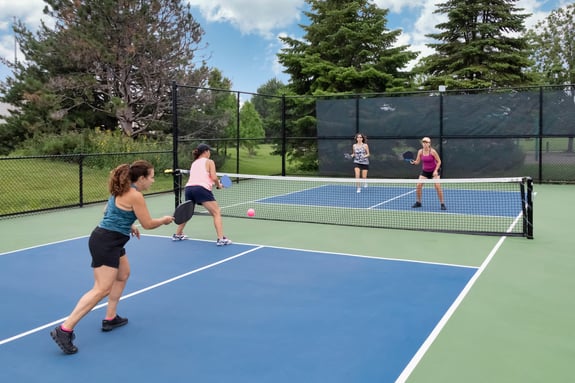
A dedicated pickleball court is built almost exactly like a tennis court, with compacted base rock, a one percent slope, pavement, curing, and then coatings and equipment. In today's market, that typically runs a pickleball court cost of about forty to forty-five thousand dollars. Extras such as perimeter fencing, dividers, awnings, or lighting push the number up from there.
When Conversion Makes Sense
The economics of conversion are hard to beat. A tennis court occupies about seven thousand two hundred square feet while a pickleball court needs only about eighteen hundred, so an underused tennis court can be restriped into four pickleball courts or turned into a multi-sport court that serves several games at once. Space-constrained communities benefit twice, since conversions sidestep the parking demands that new dedicated courts create, and even some older high-rise condominiums are repurposing underused rooftop areas the same way.
“I don't think that pickleball is really an amenity that owners are kind of deciding whether or not people want. I think the question is really much more about how much capacity do we need, and where are we going to put it.” - Pedro Obregon, Armor Courts
Padel Enters the Picture
Interest in padel is climbing quickly, especially across South Florida, and it introduces construction demands unlike anything on a tennis or pickleball court. Boards evaluating it should understand both the game and why its price tag runs higher.
A Game Played Off the Walls
Padel is essentially a blend of tennis and squash, played with a solid paddle on a court about a third the size of a tennis court, making it larger than a pickleball court but far more compact than a full tennis layout. Its defining feature is the enclosure: the court is surrounded by tempered glass walls that are part of play, so a ball rebounding off the glass stays live much as it would in squash.
Why Padel Costs More
Building padel is less about pouring a surface and more about erecting a structure. The court arrives as a kit, a steel frame with tempered glass walls, artificial turf, integrated lighting, and netting, all of which must be anchored into a reinforced concrete foundation. That foundation is engineered specifically for the enclosure, with a slab several inches thick and a perimeter ring beam considerably deeper to hold the anchor bolts, and the electrical conduit for the lighting has to be cast into the slab before the pour. Those requirements make padel noticeably more capital intensive than a comparable pickleball installation, and typically more than boards first expect.
Building Courts That Last
The gap between a court that becomes a beloved amenity and one that becomes a recurring headache rarely comes down to the surface a board can see. It comes down to whether the work beneath that surface was done correctly, whether water was engineered off the court from day one, and whether the board planned for the full life of the asset instead of the lowest opening bid. Treating a new court as a deliberate capital improvement, planned into reserves and entrusted to a qualified Florida sports court contractor chosen for building it right rather than fastest or cheapest, is what turns a large expense into a durable investment in the community's value for years to come.
Frequently Asked Questions
Can we convert a clay tennis court into pickleball courts as easily as a hard court?
No. Because a clay court is graded and built differently, converting it to paved pickleball is a full reconstruction, roughly two to three months of work that can run around one hundred twenty-five thousand dollars.
Do we need city approval or a permit to convert an existing court?
Restriping and resurfacing an existing court generally needs no permit, since nothing new is being built. A brand-new court or an enclosed padel structure is different and should be confirmed with your local building department.
Are basketball and bocce courts built the same way?
A basketball court uses the same hard-court process, sized eighty-four by fifty or ninety-four by fifty feet. Bocce is smaller, about ten to twelve feet by sixty to sixty-five feet, and finished in turf, clay, or crushed oyster shell instead of acrylic.
Keep up with our blog for valuable insights, industry updates, practical resources, and highlights from our educational webinars.
Ashley Dietz is the VP of Marketing at Campbell Property Management and has led the company’s educational and marketing initiatives since 2013. A Florida Atlantic University graduate with a bachelor’s degree in communications, Ashley specializes in community association education, digital outreach, and industry engagement for Florida HOAs and condominiums.